Your practical guide to sunscreen. Which filters actually protect you?


Sunscreen is one of the most debated topics in skincare right now. Some people say you should wear it every single day. Others say it's full of harmful chemicals. The truth? Both sides have a point. But the nuance matters. Here's the science behind UV filters, which ones have been flagged, which ones are actually brilliant, and how to pick the right sunscreen for your skin.
Where my personal story with sunscreen started
OK so I need to be honest with you. I used to be a die-hard mineral sunscreen person.
Like, I was that person who would look at an ingredient list and if I saw zinc oxide or titanium dioxide, I felt safe. I knew those names. I understood them. They sit on top of your skin and reflect the light. Simple. Clean. No scary chemicals.
And then I actually started formulating sunscreens and using them everyday.
And let me tell you. The moment you try to make an SPF 50 product using only zinc oxide, you realize very quickly that life is not that simple. The texture is thick. Your skin dries out. You look like a ghost. Even when the rest of the formula is packed with rich emollients and hydrating ingredients, the zinc just... wins. It dominates the entire feel of the product.
So I started digging into the world of chemical filters. And that's where things got really interesting. Because not all chemical filters are the same. Not even close. Some have rightfully been flagged for safety concerns. Others are genuinely some of the best UV protection technology we have today. And confusing the two is where a lot of the current sunscreen panic comes from.
Let me walk you through it.
First things first: why you need sun protection (No, the controversy doesn't change that)
Before we get into the filter drama, let's be clear about one thing. UV radiation causes real, measurable damage to your skin. We're talking DNA damage, collagen breakdown, hyperpigmentation, premature aging, and increased risk of skin cancer. This is not debatable. It is one of the most well-documented phenomena in dermatology.
Now, does that mean you have to wear sunscreen every single second of your life? No. Physical coverage works too. A hat, sunglasses, long sleeves. If you can cover up, cover up. But let's be real: when it's 30 degrees and you're at the beach, you're not wearing a turtleneck. And your face? Your face is almost always exposed. That's where sunscreen comes in.
So the question isn't whether you need UV protection. The question is: which sunscreen do you pick?
The two types of UV filters: Mineral vs. Chemical
Every sunscreen on the market works with one of two types of filters, or sometimes a combination of both.
Mineral (physical) filters
These are zinc oxide (ZnO) and titanium dioxide (TiO2). And here is where I have to correct something I believed for years, and something you will still read on almost every sunscreen box: that mineral filters work like tiny mirrors that bounce UV away from your skin.
They don't. Or at least, not in the way we all thought (and to be honest, I corrected this blogpost based on feedback and further readings).
In 2016, a team measured exactly what happens to UV light when it hits zinc oxide and titanium dioxide. They put both minerals on plates at realistic use levels and used an optical integrating sphere, which is a device that captures light going in every direction, so nothing gets missed. The result: across the whole UV range, these minerals reflected and scattered less than 5% of the UV light. Everything else, so roughly 95%, was absorbed (Cole et al., 2016). Later measurements on finished, real-life mineral sunscreens landed in the same range, around 5 to 6%, and part of even that came from the cream base itself rather than from the minerals.
Which means that mineral filters and chemical filters do fundamentally the same thing: they absorb UV energy and release it as heat. The difference is what does the absorbing. In a chemical filter it is a single molecule with a ring structure. In a mineral filter it is a crystal. That's it.
So why did the mirror story stick around for so long? Because of the white cast. Zinc oxide and titanium dioxide really do reflect a lot of light, but in the visible range, not the UV range. That same study measured 30 to 60% reflection in visible light. That's the ghost face. So your eyes see the reflecting part, and everyone assumed the UV part worked the same way. Understandable, but wrong.
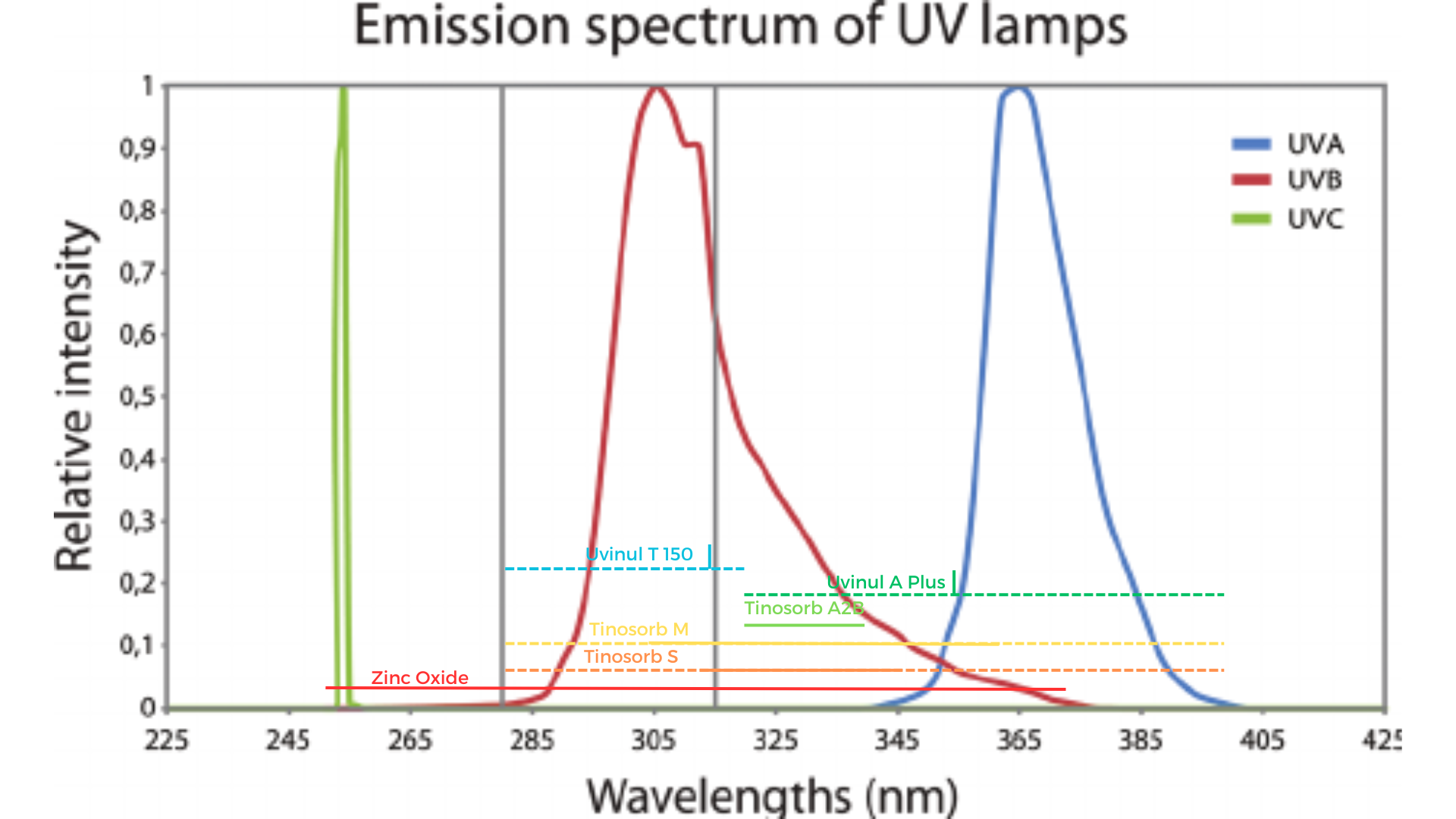
Does this change whether you should use them? Not really, and I want to be clear about that. Everything that made mineral filters attractive is still true: they are extremely well-studied, they stay on the surface of your skin, they are not absorbed into your bloodstream in any meaningful way, and they start working the moment you apply them (no 20-minute wait). Zinc oxide in particular covers a really impressive range of the UV spectrum: UVB, UVA II and UVA I, almost uniformly. It is considered one of the broadest single UV filters available (Abdel Azim et al., 2024).
What it does change is the argument. If someone tells you mineral sunscreen is better because it "physically blocks" UV while chemical sunscreen "absorbs chemicals into your skin", that reasoning does not hold up. Both absorb. The real differences between the two are where the filter sits, how photostable it is, and how the product feels on your face. Which brings me back to the texture problem.
Now, there's an important detail here: you want non-nano zinc oxide. Nano-sized particles (smaller than 100 nm) are used to reduce the white cast, but the trade-off is that they lose part of their protection in the longer UVA range and, in theory, have a higher chance of penetrating the skin. Non-nano particles stay on the surface where they belong and give you that full broad-spectrum coverage.
But here's the honest truth. Have you ever used a full SPF 50 zinc oxide sunscreen? On your face?
Tell me your honest experience.
Because mine was... not great. It dried my skin out completely. And I don't have dry skin. The formula I tested had a beautifully rich base, packed with emollients. It didn't matter. Once you add enough zinc oxide to hit SPF 50, the product just becomes chalky, heavy, and drying. That's the reality of high-SPF mineral sunscreens. It's physics. You need a lot of those particles to get serious protection, and a lot of particles means a lot of texture issues.
And that's where chemical filters enter the picture.
Chemical (organic) filters
Chemical filters absorb UV radiation and convert it into heat, which is then released from the skin. As you just read, that is the same basic mechanism as the minerals. The difference is that here the absorbing is done by a single organic molecule sitting in the formula, and different molecules are tuned to different parts of the UV spectrum. They do not need to react with your skin cells to work. They simply catch the UV energy before it reaches your DNA.
And here's the thing: the category "chemical filters" is enormous. It includes everything from filters that were developed in the 1970s to cutting-edge molecules designed in the last two decades. Lumping them all together is like saying "all medications are the same." They are absolutely not.
The controversy: which filters have actually been flagged?
OK so let's address the elephant in the room. Yes, there are chemical UV filters that have been flagged for legitimate safety concerns. This is not fearmongering. It's real science.
The main ones to know about:
Oxybenzone (Benzophenone-3). This one has been the poster child of sunscreen controversy. Two landmark studies by Matta et al., published in JAMA and conducted by the US FDA itself, showed that oxybenzone is absorbed into the bloodstream at concentrations far exceeding the FDA's 0.5 ng/mL safety threshold. In the 2019 study, plasma levels reached up to 209.6 ng/mL. That is over 400 times the threshold (DOI). The follow-up study in 2020 confirmed this finding across multiple product formulations (DOI). On top of that, oxybenzone has demonstrated estrogenic and anti-androgenic activity and interference with steroidogenic enzymes (Dutta et al., 2025). It has been restricted in the EU and banned in places like Hawaii and Palau for its damaging effects on coral reefs.
Octocrylene. Here's a sneaky one. Octocrylene itself was considered relatively safe for a long time. But then researchers discovered that it degrades over time into benzophenone, which is a known mutagen, carcinogen, and endocrine disruptor. Downs et al. (2021) showed that benzophenone accumulates in octocrylene-containing sunscreens as the product ages, and that this contamination increased significantly during accelerated stability testing. In the US, benzophenone is banned as a food additive. Yet it's forming inside your sunscreen bottle on the shelf (DOI).
Oh and, I picked up a sunscreen with octocrylene when I was in the US and damn, that things stinks (and yes it's really the filter itself).
Homosalate. This filter has shown estrogenic and anti-androgenic effects in experimental models. Lee et al. (2023) demonstrated that homosalate exposure significantly decreased testosterone levels and disrupted the steroidogenic pathway in zebrafish, with estrogenic effects observed at environmentally relevant concentrations (DOI). The EU Scientific Committee on Consumer Safety (SCCS) has recommended lowering its maximum permitted concentration from 10% to 7.34% in 2023, precisely because of these endocrine concerns.
Octinoxate (Ethylhexyl Methoxycinnamate). Another older-generation filter with documented endocrine-disrupting properties and poor photostability. It degrades significantly under UV exposure and can destabilize other filters in the formula (Freitas et al., 2015). Like oxybenzone, it has been banned in Hawaii for coral reef protection and restricted under EU regulations.
So is the controversy justified? For these specific filters: yes. Absolutely. The science is there.
But. And this is a big but.
These are not the only chemical filters that exist. And this is where the story takes a turn.
The novel filters: the ones you should actually be excited about
While the filters above were making headlines for the wrong reasons, a newer generation of UV filters was being developed. These are sometimes called "next-generation" or "novel" filters, and they are genuinely impressive. They were specifically designed for high photostability, broad-spectrum protection, and a strong safety profile.
Here are the key ones to know:
Tinosorb S (INCI: Bis-Ethylhexyloxyphenol Methoxyphenyl Triazine). Yes, the INCI name is a mouthful. But this filter is considered one of the best sunscreen agents available today. It provides true broad-spectrum protection covering the entire UVB and UVA range (280 to 400 nm) with peak protection at around 310 nm and 345 nm. It is extremely photostable, meaning it barely degrades under UV exposure. It also helps stabilize other less stable filters in the formula (like avobenzone). And crucially: it has a great safety profile. Unlike some older chemical filters, Tinosorb S does not show estrogenic activity and is not meaningfully absorbed into the skin. A comparative study of 18 sunscreen agents available in the EU found that Tinosorb S provided the highest SPF protection when used at its maximum permitted concentration (Freitas et al., 2015).
Uvinul A Plus (INCI: Diethylamino Hydroxybenzoyl Hexyl Benzoate). This one is designed specifically for high UVA protection. It covers the full UVA range (320 to 400 nm) with peak protection at 354 nm. It's highly photostable and has a clean safety profile. Can be used up to 10% in formulations worldwide (except the US and Canada, where it's not FDA-approved).
Uvinul T 150 (INCI: Ethylhexyl Triazone). This filter provides the highest photostable absorption of all available UVB filters today. It protects in the UVB range (280 to 320 nm) with peak protection at 314 nm. It's oil-soluble, odorless, and colorless. Can be used up to 5% worldwide (again, except the US and Canada).
Tinosorb M (INCI: Methylene Bis-Benzotriazolyl Tetramethylbutylphenol). A unique "hybrid" filter that works both as a chemical absorber and as a physical scatterer of UV light. It provides broad-spectrum UVA and UVB coverage. The downside? Similar to mineral filters, it can leave a slight white cast. But it has a great safety profile: it is not absorbed into the skin and does not show estrogenic activity.
Now here's the really cool part. If you map these filters onto the UV spectrum, you'll see that Tinosorb S covers a beautiful broad range across both UVA and UVB. Uvinul T 150 fills in the UVB range with the highest absorption of any available filter. And Uvinul A Plus locks down the deep UVA range. Combine two or three of these, and you get incredibly comprehensive, photostable, high-SPF protection.
And these filters have been extensively tested for exactly the safety concerns that flagged the older filters. They do not show the endocrine-disrupting activity, they do not degrade into harmful byproducts, and they have low systemic absorption. They were designed to be better. And they are.
Why you probably can't find these in the US
Quick note for my American readers (quite a low chance I have any, but still ;)): if you're wondering why you've never seen Tinosorb S or Uvinul A Plus on your sunscreen label, it's because the FDA has not approved these newer filters. Not because they're unsafe, but because the FDA's regulatory process for new sunscreen ingredients has been notoriously slow. These filters are widely approved and used in Europe, Australia, South Korea, Japan, and most of the rest of the world. In the EU, they're regulated under the Cosmetics Regulation (EC No 1223/2009) with established maximum concentrations and safety evaluations (Lodén et al., 2011).
This is actually one reason Korean and European sunscreens have such a strong reputation. They have access to the best filter technology available.
The hybrid approach: best of both worlds
Here's what I've come to appreciate after formulating with these ingredients. You don't have to choose one or the other. A hybrid approach, combining zinc oxide with novel chemical filters, can give you genuinely excellent protection.
Here's why this works so well: zinc oxide provides that broad, reliable mineral base, especially strong in the UVA range. Then you layer in a novel chemical filter like Tinosorb S or Uvinul T 150 to boost UVB protection and overall SPF without needing to pile on so much zinc that your skin turns into the Sahara. You get high SPF, broad spectrum, good texture, and a clean safety profile.
This is actually what many of the best-formulated Korean sunscreens do. And it's where I've personally landed after years of digging into this space.
How to read your sunscreen label: UVA ratings explained
OK so you know about SPF. SPF measures protection against UVB radiation, the rays that cause sunburn. But UVA is equally important. UVA penetrates deeper into the skin, breaks down collagen, drives photoaging, and contributes to skin cancer risk. You need UVA protection too.
The tricky thing is that UVA protection is labeled differently depending on where you are in the world.
In Europe: look for the UVA circle on the packaging. This is a round logo with "UVA" inside a circle. It means the product provides UVA protection that is at least one-third of the labeled SPF value. So an SPF 30 with the UVA circle gives you at least a UVA protection factor of 10. This is regulated under EU Cosmetics Regulation recommendations and is the most common standard you'll see on European products.
In South Korea and Japan: they use the PA system, which stands for "Protection Grade of UVA." It uses plus signs to indicate the level of protection:
- PA+ = some UVA protection (UVAPF 2 to 4)
- PA++ = moderate UVA protection (UVAPF 4 to 8)
- PA+++ = high UVA protection (UVAPF 8 to 16)
- PA++++ = extremely high UVA protection (UVAPF 16+)
If you're shopping for Korean sunscreens (which, honestly, I'd recommend), aim for PA++++. Many Korean sunscreens formulated with the novel filters easily achieve this rating.
In the US: you'll see "Broad Spectrum" on the label, which means the product has passed the FDA's broad-spectrum test. However, this is a pass/fail designation and does not tell you the actual UVA protection level. It is the least informative labeling system of the three.
SPF boosters: the ingredients that make your sunscreen smarter
Beyond the UV filters themselves, there are ingredients that can actually boost the overall sun protection factor of a formula. These are sometimes called SPF boosters, and most of them are powerful antioxidants. They work by neutralizing the free radicals and reactive oxygen species (ROS) generated by UV exposure, effectively complementing the UV filters and reducing the amount of filter needed to reach a given SPF.
Why does this matter? Because less filter in the formula generally means a more elegant texture, less potential for irritation, and room for other beneficial skin care ingredients.
Here are some worth knowing about:
Iron oxides (CI 77491, CI 77492, CI 77499). These are the pigments used in tinted sunscreens. And they do way more than just add color. Iron oxides absorb visible light and provide additional UVA protection. A review by Lyons et al. (2020) in the Journal of the American Academy of Dermatology demonstrated that tinted sunscreens containing iron oxides provide protection against visible light that standard UV-only sunscreens do not offer (DOI). This is especially relevant for people dealing with melasma or hyperpigmentation, where visible light is a known trigger. A randomized, double-blind trial by Castanedo-Cazares et al. (2014) showed that sunscreens containing iron oxide (UV + visible light protection) led to 15% greater improvement in melasma severity compared to UV-only sunscreens (DOI). Iron oxides also counterbalance the white cast of mineral filters, which is a nice practical bonus.
Natural astaxanthin. You knew I was going to mention this one. Astaxanthin, derived from the microalga Haematococcus pluvialis, is one of nature's most potent antioxidants. As a carotenoid, astaxanthin has direct light-absorbing properties in the visible light spectrum and powerful antioxidant capacity: it scavenges reactive oxygen species and modulates UV-induced gene expression, providing a layer of photoprotection that complements the UV filters (Balić & Mokos, 2019). When included in a sunscreen formula, it can effectively boost SPF while also delivering real skin health benefits.
Grape seed extract, green tea extract, pongamia extract. These are other examples of botanical antioxidants that have demonstrated photoprotective properties in research settings. They help mop up free radicals generated by UV exposure and can support the overall efficacy of the sunscreen formula.
What's exciting about SPF boosters is that they extend protection beyond the UV spectrum. Filters handle UVA and UVB. Iron oxides handle visible light. Carotenoids like astaxanthin add antioxidant defense across the board. Together, you get a much more comprehensive protection package than filters alone can deliver.
A note on skin that easily clogs
If you have acne-prone or congestion-prone skin, you might have noticed that some sunscreens break you out. This is often related to the type of filter and the base formula. Heavy mineral sunscreens with thick zinc oxide loads can sometimes clog pores, despite the common belief that mineral = better for sensitive skin.
Novel chemical filters like Tinosorb S and Uvinul A Plus tend to be lighter in texture and easier to formulate into elegant, non-comedogenic products. Many Korean sunscreens take advantage of this and create products that are genuinely comfortable for oily and acne-prone skin types. Something to keep in mind when shopping.
OK Emma great, now what's the actual takeaway?
Here's my practical recommendation, based on what the science says and what I've learned from actually formulating these products:
If SPF 30 is enough for you (daily indoor life, moderate sun exposure): a full mineral sunscreen with non-nano zinc oxide can work well. You'll get broad-spectrum protection with a straightforward, well-studied ingredient. Just know that the texture will be thicker.
If you want SPF 50 (which is what I recommend for most people, especially in summer): go for either a hybrid approach (zinc oxide + novel chemical filters) or a full chemical sunscreen formulated with the novel filters. This gives you high SPF, strong UVA protection, great photostability, and a texture that you'll actually want to wear every day.
Regardless of SPF level: look for products that also contain SPF-boosting antioxidants like iron oxides (especially in tinted formulas), natural astaxanthin, or grape seed extract. These extend your protection beyond just UV and add real skin care value.
What to avoid: oxybenzone, octocrylene, homosalate, and octinoxate. If you live in the EU, the good news is that the most problematic ones are already restricted or under review. But it's still worth checking your ingredient list.
How to recognize the novel filters on your ingredient list: manufacturers are required to use INCI names, not trade names. So you won't see "Tinosorb S" on the label. You'll see Bis-Ethylhexyloxyphenol Methoxyphenyl Triazine. And "Uvinul A Plus" appears as Diethylamino Hydroxybenzoyl Hexyl Benzoate. And "Uvinul T 150" shows up as Ethylhexyl Triazone. I know, they're long names. But once you know what you're looking for, they're actually not that hard to spot. There are only a handful of novel filters, so after checking a few labels you'll start recognizing them immediately.
One more thing: Korean sunscreens are often a great place to start if you want to find products formulated with these novel filters. The Korean beauty market has been ahead of the curve on sunscreen innovation for years, and there are some genuinely excellent, affordable options out there.
The bottom line
The sunscreen controversy isn't baseless. Certain older UV filters have real, documented safety issues. But the answer is not to stop wearing sunscreen. The answer is to pick a better sunscreen. The technology is there. The novel filters are effective, photostable, and safe. The science supports them. And when you combine them with SPF-boosting antioxidants like iron oxides and natural astaxanthin, you get something that's not just UV protection but genuine skin care.
Wear your sunscreen. Just make it a good one.
Welcome to Skinsights. I dive in the science behind skincare so you don't have to.
Scientific References
- Abdel Azim, S. et al. (2024). Sunscreens part 1: Mechanisms and efficacy. Journal of the American Academy of Dermatology, 92(4), 677-686. DOI
- Matta, M.K. et al. (2019). Effect of Sunscreen Application Under Maximal Use Conditions on Plasma Concentration of Sunscreen Active Ingredients: A Randomized Clinical Trial. JAMA, 321(21), 2082-2091. DOI
- Matta, M.K. et al. (2020). Effect of Sunscreen Application on Plasma Concentration of Sunscreen Active Ingredients: A Randomized Clinical Trial. JAMA, 323(3), 256-267. DOI
- Dutta, S. et al. (2025). Polycystic Ovary Syndrome (PCOS)-Specific Risk Appraisal of the Sunscreen UV Filters (Oxybenzone/Octinoxate). Toxics, 13(11), 927. DOI
- Downs, C.A. et al. (2021). Benzophenone Accumulates over Time from the Degradation of Octocrylene in Commercial Sunscreen Products. Chemical Research in Toxicology, 34(4), 1046-1054. DOI
- Kwon, B. & Choi, K. (2021). Occurrence of major organic UV filters in aquatic environments and their endocrine disruption potentials: A mini-review. Integrated Environmental Assessment and Management, 17(5), 940-950. DOI
- Lee, S. et al. (2023). Single and mixture toxicity evaluation of avobenzone and homosalate to male zebrafish and H295R cells. Chemosphere, 343, 140271. DOI
- Ebert, K.E. et al. (2024). Toxicokinetics of homosalate in humans after dermal application. Archives of Toxicology, 98(5), 1383-1398. DOI
- Freitas, J.V. et al. (2015). Photostability evaluation of five UV-filters, trans-resveratrol and beta-carotene in sunscreens. European Journal of Pharmaceutical Sciences, 78, 79-89. DOI
- Lyons, A.B. et al. (2020). Photoprotection beyond ultraviolet radiation: A review of tinted sunscreens. Journal of the American Academy of Dermatology, 84(5), 1393-1397. DOI
- Castanedo-Cazares, J.P. et al. (2014). Near-visible light and UV photoprotection in the treatment of melasma: a double-blind randomized trial. Photodermatology, Photoimmunology & Photomedicine, 30(1), 35-42. DOI
- Ng, Q.X. et al. (2020). Effects of Astaxanthin Supplementation on Skin Health: A Systematic Review of Clinical Studies. Journal of Dietary Supplements, 18(2), 169-182. DOI
- Balić, A. & Mokos, M. (2019). Do We Utilize Our Knowledge of the Skin Protective Effects of Carotenoids Enough? Antioxidants, 8(8), 259. DOI
- Lodén, M. et al. (2011). Sunscreen use: controversies, challenges and regulatory aspects. British Journal of Dermatology, 165(2), 255-262. DOI
- Cole C, Shyr T, Ou-Yang H. Metal oxide sunscreens protect skin by absorption, not by reflection or scattering. Photodermatology, Photoimmunology & Photomedicine. 2016;32(1):5-10. https://doi.org/10.1111/phpp.12214
- Schneider SL, Lim HW. A review of inorganic UV filters zinc oxide and titanium dioxide. Photodermatology, Photoimmunology & Photomedicine. 2019;35(6):442-446. https://doi.org/10.1111/phpp.12439