PDRN. Is THE hottest ingredient in K-beauty a scam?


My personal story with PDRN
A few months ago I bought a toner, mostly for the oats and calming effect, but then I saw in big on the front pack: PDRN.
I had no idea what that was. I bought the thing for the calming effect. But I am the person who writes a whole blog about the science behind skincare, so of course I could not let it go. I went digging.
And then, a couple of weeks later, I was on a call with customers in South Korea. We were talking about what is moving in their market right now, and they said it without hesitating: PDRN is the ingredient. Every brand wants it. Every launch has it. And then one of them laughed and added the part that stuck with me: "and next time it will be something else."
And once I started looking, I saw it everywhere. Not just toners. Serums, ampoules, essences, creams, sheet masks, eye creams. It has jumped format completely, which is exactly what happens when an ingredient becomes a trend rather than a formulation decision (Cosmetics Business). And on top of all of that, there is the injectable version you get in a clinic, which is where this whole story actually started.
That last part turns out to matter more than anything else. So let's look at what is real here, because there is real science underneath this one. It is just not always the science that is printed on the bottle.
First, the short version
Here is the entire post in one table, if you only have a minute:
So what is PDRN, really?
PDRN stands for polydeoxyribonucleotide. Try saying that out loud once and then never again.
It is DNA, cut into fragments and purified. And yes, it does come from salmon. More precisely, it is extracted from the sperm (the milt) of chum salmon, Oncorhynchus keta, or of salmon trout, Oncorhynchus mykiss (DOI). One fish gives roughly 5 to 10 mL of milt to work with (DOI).
Two questions come up every single time here, so let me get them out of the way.
Why salmon? Because fish sperm is an extremely rich, cheap and consistent source of DNA, and because the nucleotide building blocks that make up DNA are the same in every living thing. Your cells cannot tell a salmon nucleotide from one of your own. So it is not chosen for anything mystical about salmon. It is chosen because it is a good and cheap industrial source of the exact same molecules.
Is there fish protein in it? This is the bit that matters for allergies. The purification is designed to strip that out. Pharmaceutical grade PDRN is more than 95% pure, with proteins and peptides inactivated, which is exactly what makes it usable as a medicine without immune reactions (DOI). That is a pharmaceutical standard though. It is not automatically the standard of every cosmetic raw material on the market.
It did not start in Korea. It started in a small Italian town.
This surprised me, and it is my favourite fact of this whole post.
PDRN is not a K-beauty invention. The first medicine built on PDRN was Placentex, made by a company called Mastelli in Sanremo, Italy, and it was registered back in 1994 (DOI, Mastelli). Not for glass skin. For wounds. For damaged tissue and ulcers that would not close.
So the origin story is: Italian pharma, 1990s, wound healing. Korea did not invent PDRN. What Korea did was take the injectable version, aim it at faces instead of ulcers, and turn it into an aesthetic category. That is where names like Rejuran come from. And now, a decade later, the same three letters have jumped from the clinic to the cosmetics aisle, which is where things get blurry.
How it actually works (and why the "actually" matters)
PDRN has two mechanisms:
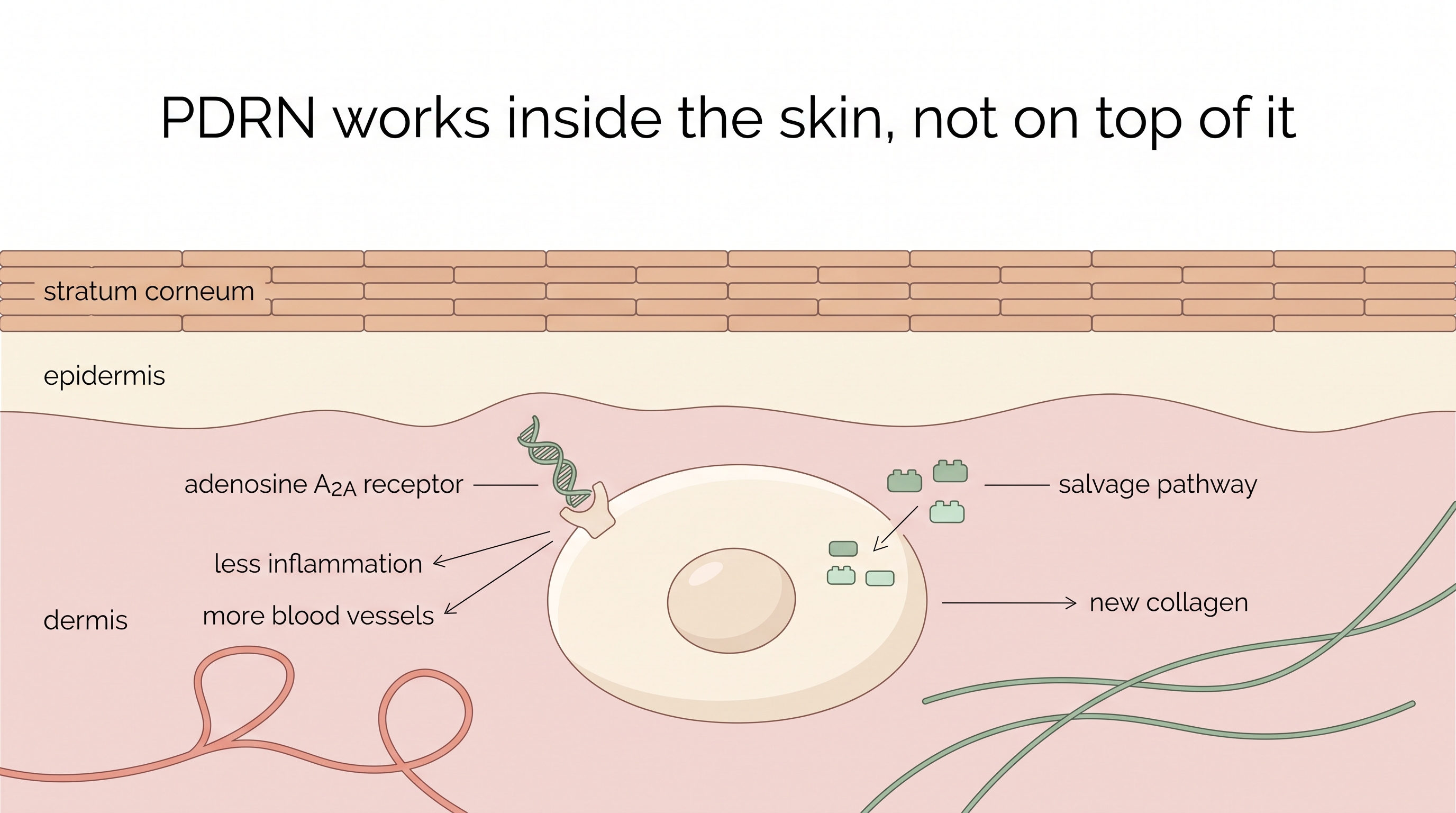
One: it feeds your cells. When PDRN breaks down, it releases nucleosides and nucleotides, which are the raw pieces cells use to build DNA. Cells have a shortcut for this called the salvage pathway, basically a recycling system. Instead of building these pieces from scratch, which costs a lot of energy, the cell picks up the ready-made ones floating around. In damaged or oxygen-starved tissue, where energy is exactly what the cell does not have, that shortcut is a big deal (DOI).
Two: it flips a receptor. PDRN activates the adenosine A2A receptor. That receptor sits on cells like fibroblasts, and switching it on raises cAMP inside the cell, calms down inflammatory signals and turns up growth factors that build new blood vessels (DOI). Less inflammation, more blood supply, more fibroblast activity. In a wound, that combination is close to ideal (DOI).
Now read those two mechanisms again and notice what they have in common. The fibroblasts are in the dermis. The A2A receptors are on cells. The salvage pathway happens inside cells.
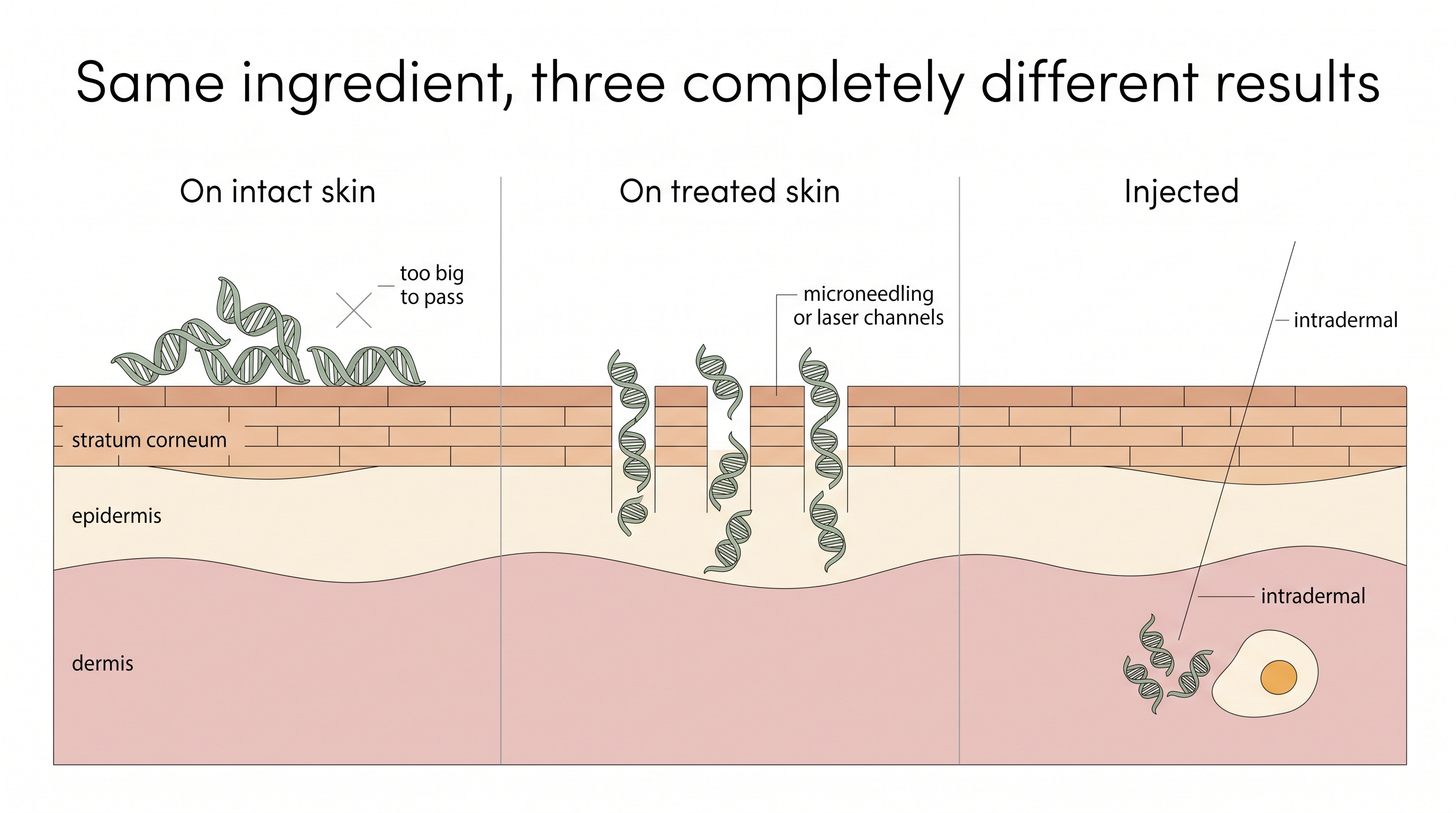
Every single part of how PDRN works requires PDRN to be inside your skin, not on it.
The size problem nobody puts on the box
Here is where it gets uncomfortable for the serums.
PDRN is not a small molecule. It is a mixture of DNA fragments weighing between 50 and 1,500 kilodaltons, with most of it clustered between 80 and 200 kilodaltons (DOI). One kilodalton is a thousand daltons. So we are talking about molecules of 50,000 to 1,500,000 daltons.
Why does that number matter? Because of a rule of thumb dermatologists have used for 25 years: the 500 dalton rule. Bos and Meinardi looked at which molecules actually cross intact skin and found that essentially all common topical drugs and contact allergens are under 500 daltons. Above that, the stratum corneum simply does not let you through (DOI).
I wrote about this in the collagen post with the truck and the mouse hole. PDRN is a much bigger truck.
This is not a controversial point, by the way. Dermatologists have said it out loud: without a delivery system, PDRN "sits on the skin surface rather than reaching its cellular targets" (Dermatology Times). A 2026 review of PDRN delivery platforms says the same thing in more careful language: naked topical application faces real penetration limits, and you need either a matrix that protects and carries the DNA or a route that bypasses the barrier (DOI).
PDRN, PN, Rejuran: what is the difference?
You will see these three words used as if they were the same thing. They are not, quite.
The PDRN and PN split is a real distinction in the literature, with PN being the longer chains and PDRN the shorter ones, and reviews describe PN as giving a more sustained effect while PDRN acts faster but shorter (DOI). It is worth knowing simply because a lot of marketing swaps the words around freely.
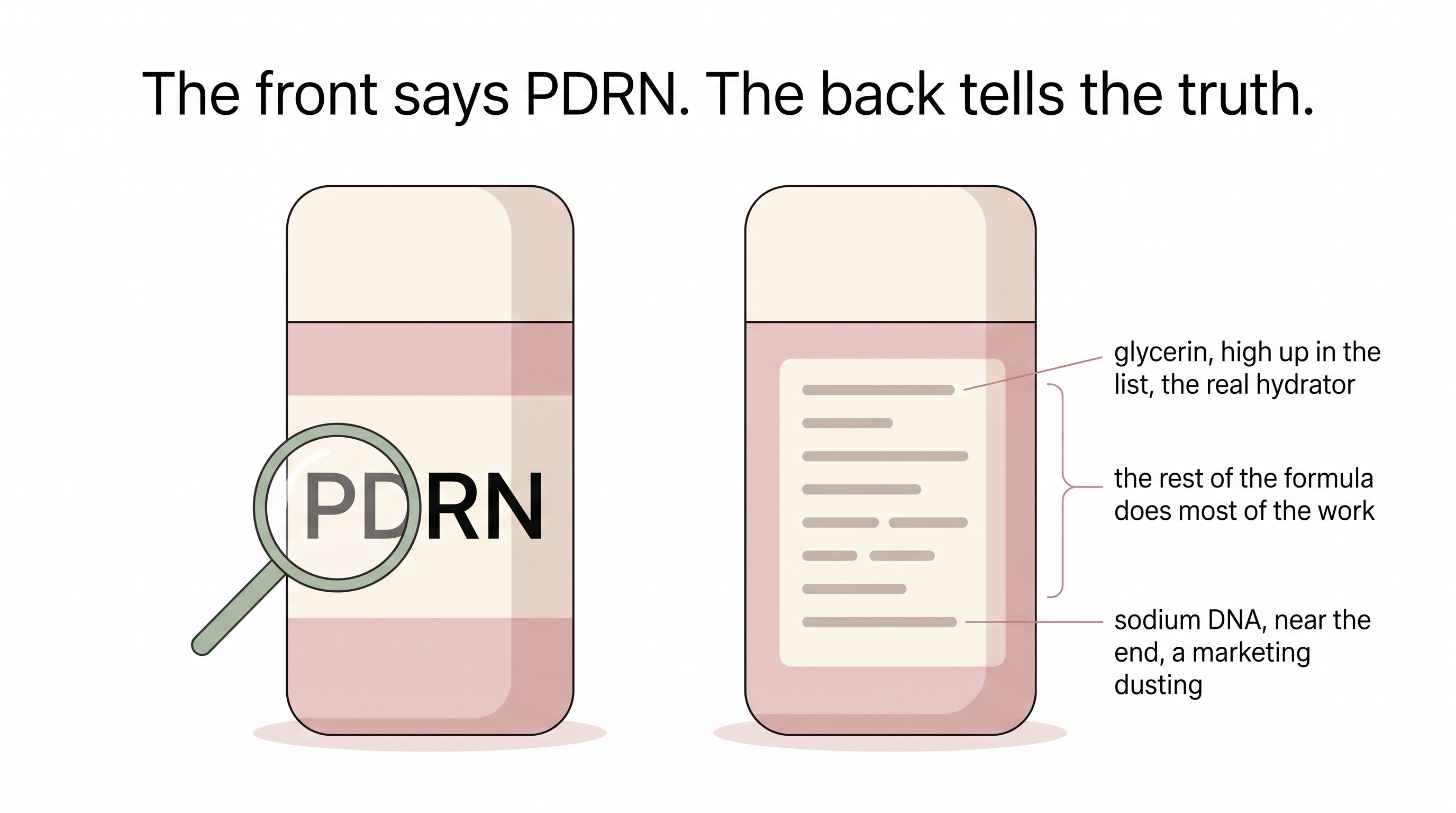
That last row is the one I would try to remember. When a cosmetic says PDRN on the front, the ingredient list will usually say sodium DNA, and its officially registered cosmetic function is skin conditioning (SpecialChem INCI). Skin conditioning. Not regenerating, not remodelling, not rebuilding.
What the injected evidence actually shows
I want to be fair here, because the injected side is genuinely impressive and I do not want to throw it out with the bathwater.
Wounds. This is the strongest data by far. In a clinical trial in people with chronic diabetic foot ulcers, PDRN given by injection roughly doubled the healing rate compared with placebo (PubMed). Reviews of the wound healing literature describe consistent improvements in cell migration, new blood vessel formation and reduced inflammation across cell, animal and human studies, with a very clean safety record (DOI).
Faces. One randomised, double blind, split face trial put polynucleotide filler on one side of 27 people's eye areas and non-crosslinked hyaluronic acid on the other. Overall aesthetic improvement scores were similar between the two sides, but the polynucleotide side did better on skin elasticity, hydration, roughness and pore volume (DOI).
We do have to be honest. A 2025 systematic review pooled the aesthetic evidence and found nine studies covering 219 patients in total. The results were promising for wrinkles, texture and elasticity. But the authors were clear that the included studies were of low to moderate quality and that rigorous trials are still needed (DOI). An expert consensus paper published this year says the same: the evidence base is still limited and there is no long term registry data yet (DOI).
So: strong for wounds, promising but thin for aesthetics, and all of it injected. Not one of those results came from a bottle you apply at home.
OK so does topical PDRN do nothing at all?
No. And this is where I want to be careful, because "it does not penetrate" and "it does nothing" are two different sentences, and the internet loves to collapse them.
Here is what a PDRN topical can honestly do.
It hydrates. DNA is a big, water loving polymer. Big polymers sitting on your skin hold water and form a light film, which reduces water loss and makes skin feel and look smoother. A dermatology review puts it plainly: topicals have limited penetration and are therefore less effective than injections, but they remain useful for maintenance and for improving skin hydration (DOI). That is a genuine benefit. It is just the same category of benefit as glycerin or hyaluronic acid, and glycerin costs nothing.
It might help on compromised skin. When the barrier is already open, the size problem goes away. That is why PDRN creams exist in wound care, and why clinics apply polynucleotides topically straight after a laser or microneedling session, once the device has made channels through the barrier (DOI). Cosmetic chemists reviewing the data landed in a similar place: worth trying if your skin is compromised or healing, not the thing to buy if your goal is anti-aging or brightening (Chemist Confessions).
The rest of the formula is doing a lot of the work. This is my favourite unglamorous truth, and it applies whatever the format is. Mine happens to be a toner with oats in it, and oats are calming, well studied and cheap. Yours might be a serum with niacinamide, or a cream with glycerin and panthenol, or a sheet mask that is essentially hyaluronic acid in a wet sheet. If your skin looks better after four weeks, the most likely explanation is that you have been consistently applying a well formulated hydrating product every day, which is genuinely good for your skin, and the 4 letters on the front had very little to do with it.
How to read a PDRN product without getting fooled
A small checklist I now run through myself:
- Turn the box around and find sodium DNA (or hydrolysed DNA) in the ingredient list. If it is sitting near the very end, after the preservatives, you are looking at a marketing dusting, not a dose.
- Ask what else is in there. If the formula is a good hydrator with niacinamide, panthenol, glycerin or oats, buy it for those. Then anything PDRN adds is a bonus.
- Be suspicious of any claim that a leave-on cosmetic "regenerates", "repairs DNA" or "stimulates fibroblasts". Those are the injected mechanisms, borrowed.
- Treat "clinically proven" carefully. Ask yourself: proven in what, injected or applied? Almost all the impressive numbers you see quoted come from injection studies.
- If you actually want the injected effect, that is a clinic conversation with a qualified injector, not a shopping decision. And know that in a lot of countries, these injectables are not approved for cosmetic use.
- If you have a fish allergy, cosmetic grade material is not held to the same purity standard as pharmaceutical grade. Patch test, and ask.
And about the hype itself
I keep coming back to what my Korean customers said. PDRN is the ingredient right now, and next time it will be something else.
They are not being cynical. They are describing how ingredient cycles work. Snail mucin had its moment. Centella had its moment. Ceramides, peptides, retinal, exosomes. An ingredient with a real, interesting mechanism gets discovered by the aesthetic clinics, gets a viral moment, and then the cosmetics industry rushes to put a version of it in a bottle, whether or not the bottle format can deliver the mechanism.
PDRN is a good example because the mechanism is completely real. The Italian pharma work is real. The A2A receptor is real. The ulcer trials are real. The problem is not that PDRN is fake. The problem is that a molecule of 50,000 to 1,500,000 daltons was asked to do something it physically cannot do from the outside of an intact stratum corneum.
When the next ingredient arrives, and it will, this is the question I would ask first: how big is it, and how is it supposed to get in?
OK Emma great, now what's the actual takeaway?
PDRN is real science with a real history. It is purified DNA from salmon sperm, developed in Italy in the 1990s to heal wounds, and it works by feeding cells nucleotides and switching on the adenosine A2A receptor. Both of those things happen inside your skin.
That is why injection is where the evidence lives. Injected PDRN and polynucleotides have solid data in wound healing and promising, though still limited, data for skin quality. Topically, on intact skin, the molecule is 100 to 3,000 times bigger than what the skin barrier lets through, so it stays on the surface.
Your PDRN serum, essence, cream or sheet mask is not a scam. It is a hydrator. A decent one, probably. Buy it for the whole formula, enjoy the glow that comes from consistent hydration, and do not pay a premium for the three letters on the front.
And when someone tells you the next ingredient will change everything, ask them how it plans to get in.
Welcome to Skinsights. I dive in the science behind skincare so you don't have to.
Scientific References
- Squadrito F, Bitto A, Irrera N, Pizzino G, Pallio G, Minutoli L, Altavilla D. "Pharmacological Activity and Clinical Use of PDRN." Frontiers in Pharmacology. 2017;8:224. DOI
- Ku JK, Yun PY, Jeong YK. "Polydeoxyribonucleotide (PDRN) in Dentistry: Narrative Review for Mechanisms and Emerging Clinical Applications." Tissue Engineering and Regenerative Medicine. 2026;23(2):209-220. DOI
- Galeano M, Pallio G, Irrera N, Mannino F, Bitto A, Altavilla D, Vaccaro M, Squadrito G, Arcoraci V, Colonna MR, Lauro R, Squadrito F. "Polydeoxyribonucleotide: A Promising Biological Platform to Accelerate Impaired Skin Wound Healing." Pharmaceuticals. 2021;14(11):1103. DOI
- Squadrito F, Bitto A, Altavilla D, Arcoraci V, De Caridi G, De Feo ME, Corrao S, Pallio G, Sterrantino C, Minutoli L, Saitta A, Vaccaro M, Cucinotta D. "The Effect of PDRN, an Adenosine Receptor A2A Agonist, on the Healing of Chronic Diabetic Foot Ulcers: Results of a Clinical Trial." The Journal of Clinical Endocrinology & Metabolism. 2014;99(5):E746-E753. PubMed
- Bos JD, Meinardi MMHM. "The 500 Dalton rule for the skin penetration of chemical compounds and drugs." Experimental Dermatology. 2000;9(3):165-169. DOI
- Arora G. "Polynucleotides and polydeoxyribonucleotides in dermatology: a narrative review." Journal of Cutaneous and Aesthetic Surgery. 2025;19:17-28. DOI
- Lee YJ, et al. "Comparison of the effects of polynucleotide and hyaluronic acid fillers on periocular rejuvenation: a randomized, double-blind, split-face trial." Journal of Dermatological Treatment. 2022;33(1):254-260. DOI
- Lampridou S, Bassett S, Cavallini M, Christopoulos G. "The Effectiveness of Polynucleotides in Esthetic Medicine: A Systematic Review." Journal of Cosmetic Dermatology. 2025;24(2):e16721. DOI
- Rho NK, Chilukuri S, Chan G, Kim MJ, Shin J, Suwanchinda A. "Expert Perspectives: Evidence-Based Applications of Polynucleotides (PNs) in Aesthetic Medicine and Dermatology." Clinical, Cosmetic and Investigational Dermatology. 2026;19. DOI
- Kim HJ, Lee JW, Kim S, Son KH. "Plant-Derived Polynucleotides/Polydeoxyribonucleotides in Skin Biomaterials: Delivery Platforms and Bioactivity Attribution." Journal of Functional Biomaterials. 2026;17(7):351. DOI
- Park S, Baek S, Shin HJ, Kim JS, Gwon HI, Bae S, An S. "Polydeoxyribonucleotides as Emerging Therapeutics for Skin Diseases: Clinical Applications, Pharmacological Effects, Molecular Mechanisms, and Potential Modes of Action." Applied Sciences. 2025;15(19):10437. DOI
- Akaberi SM, Sharma K, Ahmadi-Ashtiani HR, Hedayati M. "Polydeoxyribonucleotide in Skincare and Cosmetics: Mechanisms, Therapeutic Applications, and Advancements Beyond Wound Healing and Anti-aging." Journal of Skin and Stem Cell. 2025;12(1):e159728. DOI
- Dermatology Times. "Social Media Mythbusters: PDRN Serums." Dermatology Times
- SpecialChem. "Sodium DNA: Cosmetic Ingredient INCI." SpecialChem
- Mastelli S.r.l. "Wound Care: Placentex (PDRN)." Mastelli
- Allen J. "Cosmetics Business reveals the top 5 K-beauty trends of 2025." Cosmetics Business. 3 February 2025. Cosmetics Business
- Chemist Confessions. "PDRN Skincare: Hype vs. Reality." March 2025. Chemist Confessions