Hyaluronic acid. Let's talk about why it holds water instead of giving it.

%20(1).jpg)
My personal story with hyaluronic acid
I came to hyaluronic acid late, and for a slightly embarrassing reason.
For years my whole routine was aimed at one thing: my acne. And when you are fighting acne, your instinct is to dry everything out. Strip it, treat it, mattify it. Anything that felt rich or hydrating felt like the enemy. So I skipped all of it.
My skin was not happy. It was oily and dehydrated at the same time, which sounds like a contradiction until you have lived it. Tight after cleansing, shiny by lunch, and constantly irritated by the actives I kept piling on.
At some point it finally clicked that treating my acne and hydrating my skin were not two competing goals. They were the same goal. My skin was not going to calm down while I kept drying it out. That is when hyaluronic acid came in, and honestly, I have been a fan ever since. It was the first thing that made my skin feel comfortable without making it greasy.
But then I read what it actually does, and it was not what I thought at all.
The whole post in one table
If you only read one thing, read this:
What hyaluronic acid actually is
First thing to know: it is not really an acid, at least not in the way the acids in my acids post are. It does not exfoliate. It does not lower your skin's pH. It does not sting. The name is chemistry naming, not skincare naming.
Hyaluronic acid is a very long sugar chain. Your body makes it, and about half of all the hyaluronic acid in your entire body is sitting in your skin right now (DOI). It is mostly in the dermis, the deeper living layer, where it works as a kind of water-holding gel between your collagen and elastin fibres. The dermis holds about 0.5 mg per gram of tissue, the epidermis about 0.1 mg per gram (DOI).
The wild part is how fast it turns over. Hyaluronic acid has a half-life in skin of less than a day (DOI). Your body is constantly making it and constantly breaking it down. Compare that to collagen, which takes years, and you get a sense of how different these two molecules are, even though they get marketed side by side.
It also does more than hold water. It talks to your skin cells through a receptor called CD44. In mice that were engineered to have less CD44 in their skin, the epidermis was noticeably thinner, and after the barrier was damaged it took significantly longer to recover (DOI). So the hyaluronic acid that is naturally in your skin is part of how your barrier repairs itself. Worth remembering when we get to the part about whether the stuff in your serum ever reaches that far.
And yes, it changes with age, but not in the simple way you read online. The clearest loss is in the epidermis, which loses its hyaluronic acid quite dramatically over time. In the dermis the amount does not necessarily drop, but it becomes more locked into the surrounding tissue and less freely available (DOI). One older study using electron microscopy found the hyaluronic acid granules in the dermis progressively reduced and essentially absent in people aged 60 (DOI). So "you lose hyaluronic acid as you age" is close enough, but the honest version is "you lose access to it".
The part that changed how I use it: it is a sponge, not a drink
Here is the thing I had wrong for years.
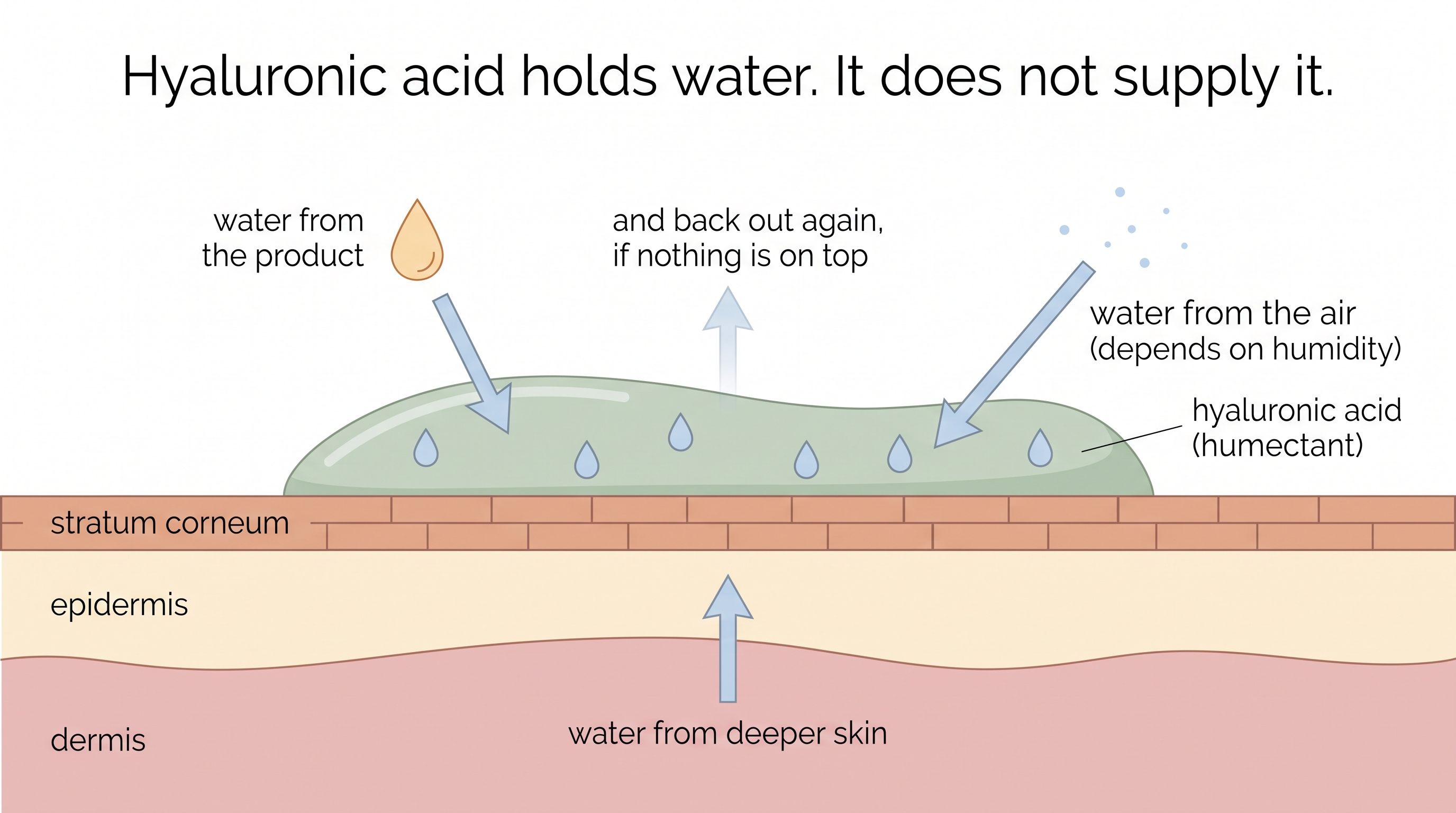
Hyaluronic acid belongs to a group of ingredients called humectants. Glycerin is one. Urea is one. Panthenol is one. What a humectant does is bind water and hold it. That is it. It does not create water and it does not carry water into your skin from nowhere.
Think of a dry sponge. A sponge is brilliant at holding water. But if you put a dry sponge on your kitchen counter, it stays dry. It needs water available before it can hold any.
The clearest way I have seen it described in the literature is this: humectants "draw water from the dermis into the epidermis" (DOI). They move water. They do not supply it. Reviews of topical hyaluronic acid classify it exactly this way, as a humectant that pulls water from the dermis toward the epidermis (DOI).
So where does the water come from?
Three places, and it matters which one.
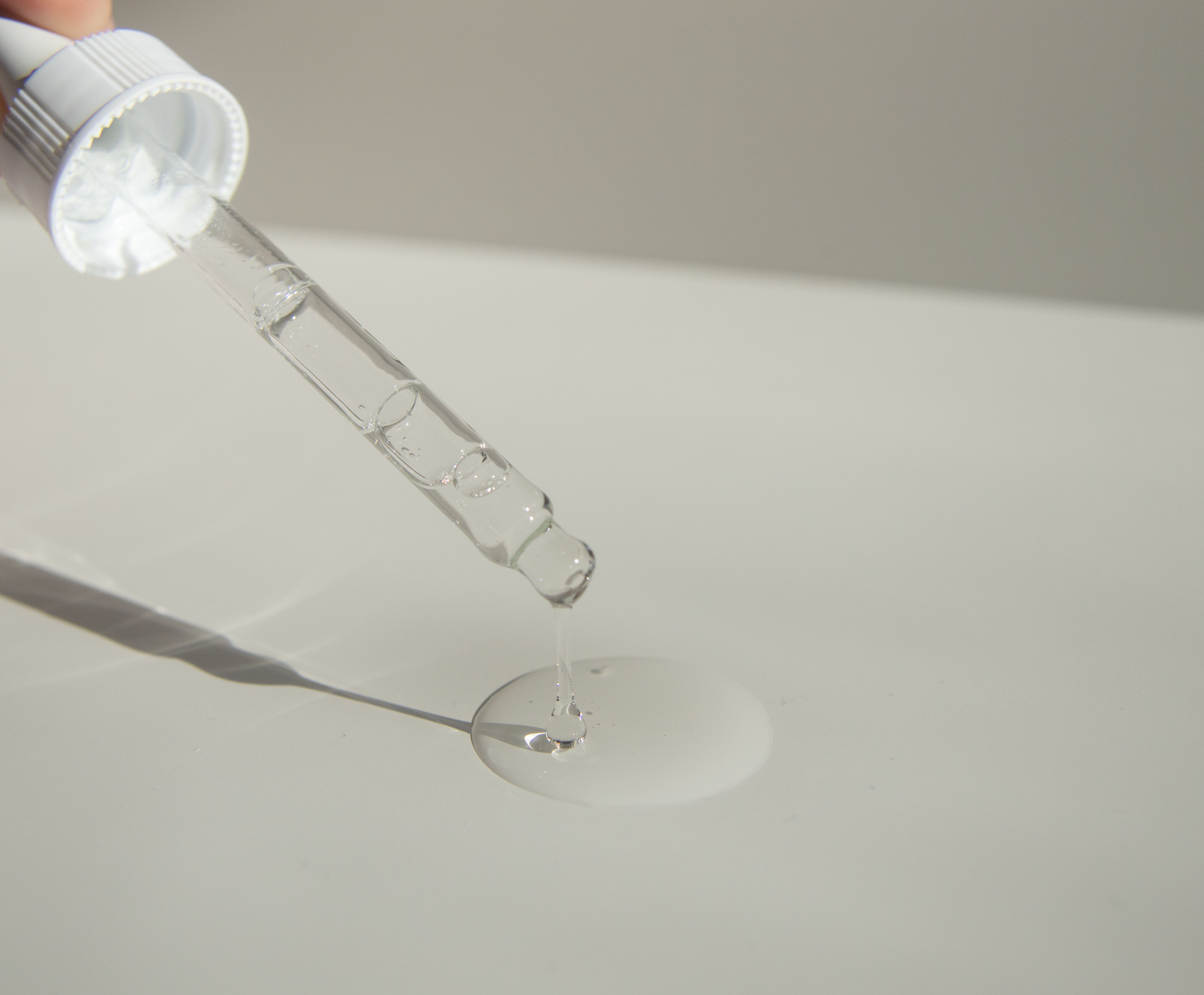
From the product itself. Most hyaluronic acid serums are 80 or 90 percent water. When you apply one, you are applying water, and the hyaluronic acid holds onto it on the surface of your skin. This is the biggest and most immediate source, and it is why hyaluronic acid feels so good the moment you put it on damp skin.
From the air. Hyaluronic acid pulls moisture out of the air around you. How much depends entirely on the humidity. This has actually been measured properly: how much water hyaluronic acid takes up varies directly with the relative humidity it is sitting in (DOI). In a Belgian autumn, plenty. On a plane, almost nothing.
From deeper in your own skin. This is the one people worry about, and we will get to it.
This is why hyaluronic acid needs something on top of it
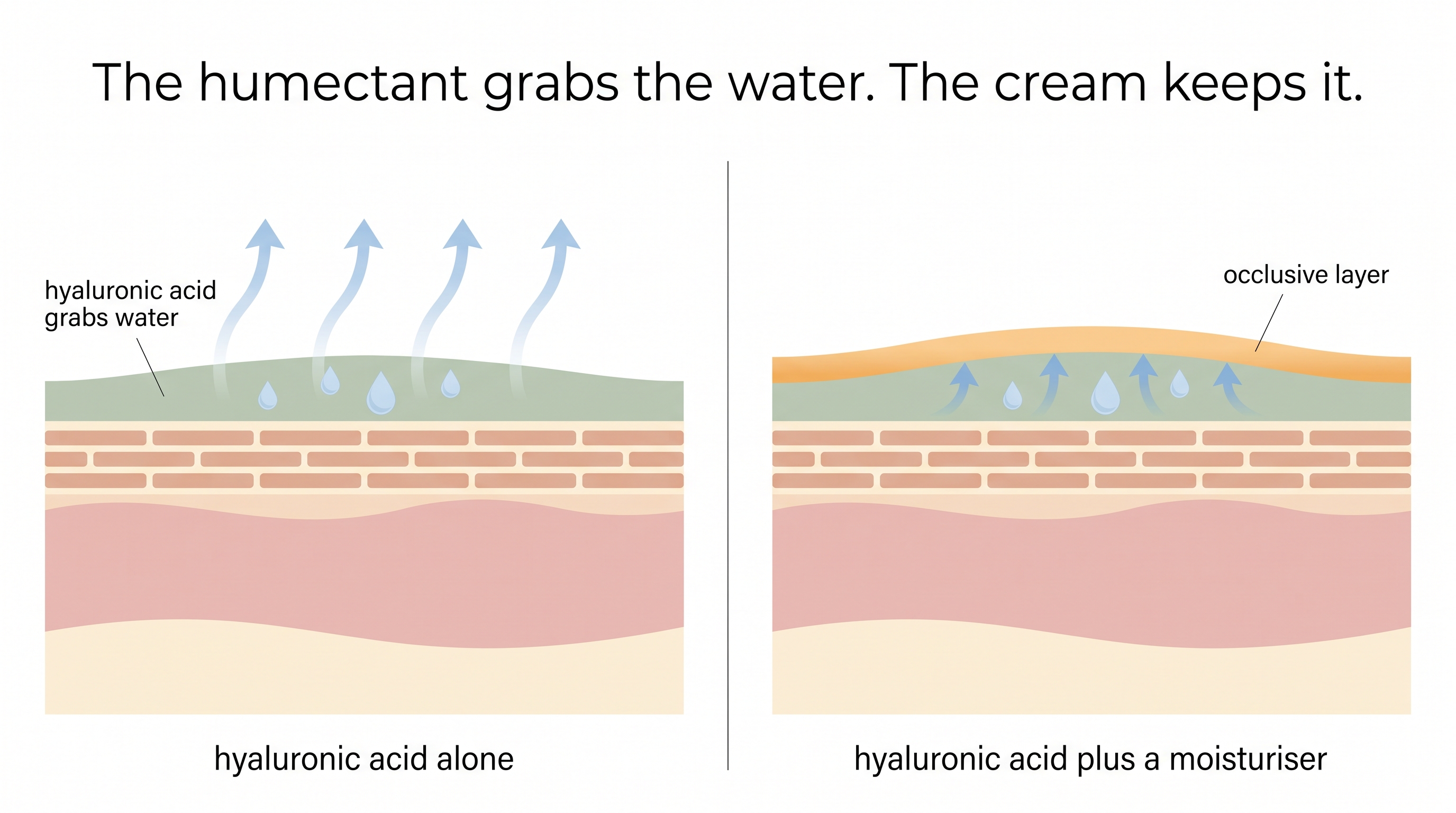
If you put a humectant on your skin and leave it exposed, the water it just grabbed can simply evaporate. The review literature says this plainly: humectants can even increase water loss through the skin by pulling water up into the epidermis where it evaporates, "therefore combination with occlusives is frequently required" (DOI).
Occlusives are the ingredients that sit on top and physically slow evaporation. Squalane, petrolatum, oils, butters, fatty alcohols, ceramide-rich creams. Humectant underneath, occlusive on top. That is the whole trick.
Which is why a hyaluronic acid serum on its own, with nothing over it, is doing maybe half its job. And why a hyaluronic acid mist with no cream after it is, in my honest opinion, mostly a nice feeling.
There is a small piece of evidence here that I found genuinely useful. In a randomised controlled trial in elderly people with dry skin, hyaluronic acid raised skin hydration readings compared to the vehicle. But there was no significant difference in transepidermal water loss between any of the groups (DOI). In plain language: the hyaluronic acid put water in the top layer, but it did nothing to stop water leaving. It is not a barrier ingredient. It never was. That job belongs to your ceramides and lipids.
About that "holds 1000 times its weight in water" line
You have seen this on every hyaluronic acid box ever made. I went looking for where it comes from, because I was curious.
It is not a made-up number, but it is not what it sounds like either. In the peer-reviewed literature the phrasing is usually "1000 times its volume in water", not weight (DOI). Those are two different statements, and the swap happened somewhere in marketing, not in science.
More importantly, the real measurements behind it are bench measurements. Dry hyaluronic acid powder in a controlled chamber at a set humidity (DOI). That is a perfectly good experiment. It just has nothing to do with what a 1 percent solution does on your cheek after you have applied it and put a cream on top.
So it is a fun fact about the molecule. It is not a promise about your face. I would not choose a product because of it.
Does hyaluronic acid dry your skin out in winter?
This one goes around the internet every single year. The claim is that in dry air, hyaluronic acid cannot find water outside, so it pulls water up from deeper in your skin and that water then evaporates, leaving you drier than before.
Let me be straight with you. No study has ever tested this. Not for hyaluronic acid, not in low humidity, not with or without a cream on top. I looked. What exists is the general humectant mechanism I described above, stated in review articles as a property of humectants as a group (DOI). Nobody has demonstrated that it happens with a hyaluronic acid serum on a normal face in a dry room.
So the mechanism is plausible. The scary version is not proven.
And here is the good news: the fix is the same either way. Put something occlusive on top. If the water cannot evaporate, it cannot be lost, and the whole question becomes irrelevant. This is exactly why I never treat hyaluronic acid as a standalone step, in any season.
Molecular weight, and why everyone is suddenly talking about it
This is where hyaluronic acid gets interesting and also where the marketing gets loud.
Hyaluronic acid is a chain. Chains can be long or short, and the length is measured in Daltons (Da) or kilodaltons (kDa). The hyaluronic acid your body makes naturally is enormous, often into the millions of Daltons. The stuff in cosmetics has been cut down to various sizes.
The names you will see on a label
Molecular weight is not part of the official ingredient naming system, so a brand cannot legally write "50 kDa" in the INCI list. What you get instead is these names:
All of these are covered by cosmetic safety reviews and have a very clean safety record on skin (DOI).
What the size actually changes
The size classes used in cosmetics are roughly: low molecular weight below 50 kDa, medium 100 to 500 kDa, high above 700 kDa (DOI). The full range found in cosmetic products runs from about 5 kDa all the way to 1800 kDa.
The story you are told is simple: big molecules sit on the surface and form a film, small molecules go deeper and plump you up from within.
The first half is right. The second half needs correcting.
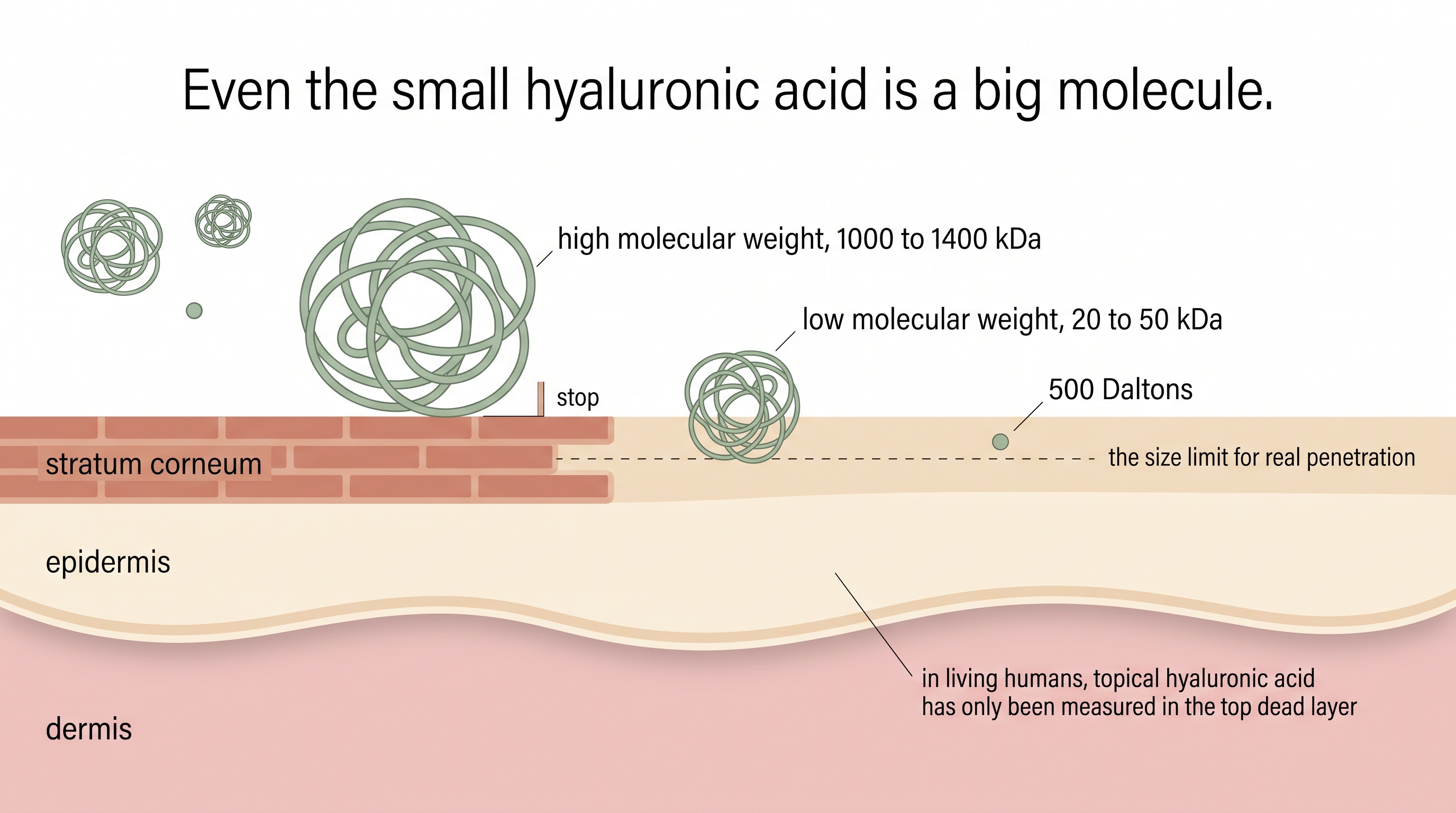
Remember the 500 Dalton rule from my collagen post? The idea that a molecule generally has to be under 500 Da to get through the top layer of your skin (DOI). Now look at the numbers again. "Low" molecular weight hyaluronic acid is 5,000 to 50,000 Da. That is ten to a hundred times over the line. Small, in hyaluronic acid terms, is still enormous in skin-penetration terms.
The study everyone cites for penetration used Raman spectroscopy and found that 20 to 300 kDa hyaluronic acid passed through the stratum corneum while 1000 to 1400 kDa did not (DOI). That is a real result. But it was done on skin samples in a lab, not on living people, and one of its authors worked for a hyaluronic acid ingredient supplier. Almost every "small molecules go deeper" claim you will ever read traces back to this one paper.
When someone finally measured it properly in living humans, with both high and low molecular weight hyaluronic acid applied daily for a week, the result was blunter. They could quantify hyaluronic acid in the stratum corneum, the top dead layer, and nowhere else. Not in the epidermis, not in the dermis (DOI). And that study came from L'Oréal's own research group, so it was not exactly written to be discouraging.
There is also a study where researchers deliberately damaged the skin barrier and then tried to use hyaluronic acid to carry a large molecule deeper. It did the opposite. The hyaluronic acid held the molecule up in the epidermis instead of letting it travel (DOI).
So does molecular weight matter at all?
Yes, but not in the direction the marketing points.
The best test of this is a trial where 76 women used creams with 0.1 percent hyaluronic acid at five different molecular weights (50, 130, 300, 800 and 2000 kDa) for 60 days, against a placebo on the other eye (PubMed: 22052267). Two findings, and the second is the interesting one.
Hydration and elasticity improved significantly at every single molecular weight, from 50 all the way up to 2000 kDa. A forty-fold difference in size, and the hydration benefit did not care. So for the thing most people buy hyaluronic acid for, molecular weight made no measurable difference.
Wrinkle depth was the one thing that separated by size. Only the 50 and 130 kDa creams significantly reduced it. That is a genuine molecular weight finding, and it is the only clean one I could find.
The other decent trial, the one in elderly people with dry skin, found low molecular weight beat high molecular weight on a hydration meter (56.4 versus 52.4 arbitrary units) with no difference in dryness as judged by a clinician (DOI). A real difference, but a small one.
Is a mix of molecular weights better?
This is the claim on almost every premium hyaluronic acid serum right now, and I want to be honest with you about it.
Mechanically it makes sense. Different sizes behave differently on the skin surface. Big ones form a smoothing film that holds water where it is. Smaller ones settle into the top layer and hold water there. Having both is a sensible piece of formulating.
What does not exist is proof that a blend beats a single weight. There is exactly one head-to-head study, and it compared a multi-weight Eucerin lotion against a single-weight CeraVe lotion (PubMed: 39263267). Two completely different products from two competing companies, one containing antioxidants and the other ceramides, and the paper does not state a single molecular weight in Daltons anywhere. Several of the authors work for the company that makes the winning product. That study cannot tell you anything about molecular weight, because molecular weight is not the only thing that changed.
My practical position: a multi-weight formula is a reasonable thing to prefer, and it is often a sign that a brand put actual thought into the formula. It is not a reason to spend three times more. And it is definitely not doing what the "penetrates deep to plump from within" copy says it is doing.
One more thing that annoys me. Molecular weight is an average, not a fixed number. Natural hyaluronic acid spans up to a fifty-fold mass range, which makes precise characterisation genuinely difficult (DOI). So a "50 kDa hyaluronic acid" is really a soup of chains around that average, containing both longer and much shorter ones. Precision in the marketing, blur in the bottle.
The bit the industry does not put on the box
Short but worth knowing. In immunology, high molecular weight hyaluronic acid is understood as an anti-inflammatory "everything is fine" signal, while small fragments are the opposite: they are what your body produces when tissue is being damaged, and they act as inflammatory alarm signals (DOI).
So the exact size range that skincare markets as the active, penetrating form is the size range that immunology calls a distress signal. That is a real tension.
Is it a problem in a serum? Almost certainly not. That immunology comes from injury, injection and disease models, not from a bit of serum on intact skin, and none of the clinical trials reported issues. But it is a good reason not to treat "smaller must be better" as an obvious truth, and a good reason to be suspicious when a brand acts like tiny fragments are automatically an upgrade.
Where you actually find hyaluronic acid, and what is worth your money
Hyaluronic acid is in almost everything now, which is exactly why you need to look at the ingredient list rather than the front of the pack. Ingredients are listed in order of how much is in there, roughly, until you get down to the small stuff. If hyaluronic acid is sitting next to the preservatives, there is not much of it.
Serums, where it actually belongs
This is the format that makes sense. A watery serum is mostly water, which is the water the hyaluronic acid holds, and it stays on your face.
The Ordinary Hyaluronic Acid 2% + B5 (with Ceramides), around €10 for 30 ml, is the clearest example of the ingredient being taken seriously. Sodium Hyaluronate is the second ingredient, with Hydrolyzed Hyaluronic Acid at five and Sodium Hyaluronate Crosspolymer at six. Three genuinely different hyaluronic acids, all near the top. Note this is the 2024 reformulation, the original is still sold separately.
The Inkey List Hyaluronic Acid Serum, around €10 for 30 ml, has Sodium Hyaluronate at three and Hyaluronic Acid at nine on a fourteen-ingredient list. Simple and honest.
CeraVe Hydrating Hyaluronic Acid Serum, around €18, puts Sodium Hyaluronate at six, above its three ceramides. This one is my kind of product because it is doing both jobs in one step: the humectant and the barrier lipids that help hold the water in.
Skin 1004 Hyalu-Cica Blue Serum, around €16 and one of my favorites. With centella, 5 hyaluronic acids, ceramide NP, niacinamide, and adenosine. Good if you're looking for a more complete formula.
One to check carefully: La Roche-Posay Hyalu B5, which is a much loved product, now sold in Belgium as the Sérum Suractivé. It advertises four forms of hyaluronic acid, and it does contain three. But Alcohol Denat. is the third ingredient, well above all of them. If your skin is sensitive or reactive, see my post on alcohol in skincare before assuming this is the gentle option.
Creams and gel creams
A cream is arguably the better format, because it brings the humectant and the occlusive together. But this is also where hyaluronic acid gets used as a marketing garnish.
Neutrogena Hydro Boost is the example I keep coming back to. The whole range is named and sold on hyaluronic acid. In the European version, Sodium Hyaluronate sits at position 20 out of 41, below nine amino acids and a ceramide, wedged between one preservative and two preservative boosters. It is a perfectly nice gel cream. It is not a hyaluronic acid product in any meaningful sense.
Skin 1004 Hyalu-Cica Moisture Cream, a lightweight cream with centella, 5 hyaluronic acids and hydrolyzed collagen. Good if you don't want to have a serum in your routine, although the serum of this range + a more occlusive cream (ceramides, etc.) will do a better job.
Mists, my least favourite way to use it
A hyaluronic acid mist is a humectant with nothing to hold it in. Look at Eucerin Hyaluron Mist Spray: Sodium Hyaluronate at position three of thirteen, which is genuinely well dosed. And then look at the rest of the list. Water, glycols, glycerin, panthenol, preservatives. There is not one occlusive ingredient in the entire formula. No oil, no silicone, no fatty alcohol, nothing.
So you spray it, it grabs water, and then nothing stops that water evaporating off your face. Mists are lovely and refreshing and I own one. Just do not count it as a hydration step unless you follow it immediately with a cream.
Cleansers and sheet masks
Hyaluronic acid in a cleanser is decoration. CeraVe Hydrating Facial Cleanser has Sodium Hyaluronate at 14 of 24, directly above the preservative, and you rinse it off in under a minute. The ceramides in that cleanser do more for you than the hyaluronic acid does.
Sheet masks are better, because they hold the product against your skin under an occlusive plastic film for fifteen minutes, which is genuinely good conditions for a humectant. Just check the list. The Garnier Hyaluronic Acid Ampoule mask has Sodium Hyaluronate at seven, and Alcohol at eight, right underneath it.
What about the hyaluronic acid you swallow?
I get asked about this a lot, so here is the short and honest version.
There are a handful of randomised controlled trials, and they mostly used 120 mg per day. A 12-week study in 60 people found reduced wrinkle volume compared to placebo, though only in the 300 kDa group and only from week 8 (DOI). A 6-week study in 61 people with dry skin found improved skin moisture versus placebo (DOI).
A 2025 meta-analysis pulled together everything that qualified and found only seven randomised trials in total. Pooled, oral hyaluronic acid significantly improved hydration, elasticity and wrinkle depth. It did not significantly improve firmness, wrinkle volume or water loss through the skin (DOI).
Now the caveats, because they are big ones. Almost every one of those trials was run or co-authored by employees of a hyaluronic acid manufacturer. The studies are small, the longest ran 12 weeks, and there is essentially no independent trial.
And the absorption story is messier than the supplement labels suggest. When researchers tested it in rats, hyaluronic acid was not broken down by stomach or intestinal juice but it was broken down by gut bacteria into much smaller fragments, which were then absorbed in the large intestine (DOI). So it does not arrive at your skin as hyaluronic acid. It arrives as pieces, if it arrives at all. And at least one independent group found essentially no absorption after oral dosing (DOI), so this is genuinely unresolved rather than settled.
Where does that leave me? Oral hyaluronic acid is not a scam, and the direction of the evidence is mildly positive. But it is thinner and far more conflicted than the evidence for, say, oral collagen peptides. If you want to try it, 120 mg a day for three months is the dose the studies used. I would spend the money on a good serum and a good moisturiser first.
And what about injectables?
Completely different category, and I am not going to give you advice on it here.
Injectable hyaluronic acid is cross-linked, meaning the chains are chemically bonded into a gel that resists being broken down by your own enzymes, which is why it lasts months instead of the day or so that your natural hyaluronic acid lasts (DOI). Skin boosters are a related but different thing, placed in the dermis to improve skin quality rather than to add volume, and they can be non-cross-linked, lightly cross-linked or fully cross-linked (DOI).
That is a medical procedure with a doctor, not a skincare choice, and it is not something I am going to weigh in on. I mention it only so you understand that "hyaluronic acid" in a syringe and "hyaluronic acid" in a serum have almost nothing in common besides the name.
How I actually use it
After all that reading, my routine got simpler, not more complicated.
On damp skin, always. Not soaking, just not fully dry. The water on your face is the water the hyaluronic acid is going to hold. If I apply it to bone-dry skin, I am giving the sponge nothing to work with.
Never as the last step. A moisturiser goes on top, every time, morning and evening. This is the single most important thing in this whole post and it costs you nothing.
Do not chase the highest percentage. Too much humectant can actually feel sticky and, in very dry air, uncomfortable. Reported use levels in cosmetics are mostly well under 1 percent for a reason. A 2 percent product is not twice as good as a 1 percent one.
It goes with everything. This is the genuinely lovely thing about hyaluronic acid. It is not an active, it does not have a pH requirement, and it does not compete with anything. Vitamin C, retinol, niacinamide, acids, all fine. If anything it makes irritating actives easier to tolerate. See my post on combining actives for the ones that actually clash.
Oily skin still needs it. This is the mistake I made for years. Oil is not water. You can be greasy and dehydrated at the same time, and a light hyaluronic acid serum under a gel moisturiser was what finally broke that cycle for me.
OK Emma great, now what's the actual takeaway?
Hyaluronic acid is a sponge, not a drink of water. It holds water beautifully, but you have to give it water to hold, and you have to stop that water escaping. Apply it on damp skin and put a moisturiser on top. That is 90 percent of getting it right.
Molecular weight is a real thing, and it is oversold. Hydration works at every size that has been tested. The one genuine size-specific finding is on wrinkle depth at the smaller weights. A multi-weight formula is a reasonable preference, not a reason to pay a premium, and nothing in a bottle is reaching your dermis.
Check the ingredient list, not the front of the pack. Second ingredient means something. Position 20 out of 41, sandwiched between preservatives, does not.
And you do not need to spend much. The €10 serum with hyaluronic acid at position two is doing more than the €50 cream with it at position 20.
Welcome to Skinsights. I dive in the science behind skincare so you don't have to.
Scientific References
- Papakonstantinou E, Roth M, Karakiulakis G. "Hyaluronic acid: A key molecule in skin aging." Dermato-Endocrinology. 2012;4(3):253-258. DOI
- Chylińska N, Maciejczyk M. "Hyaluronic Acid and Skin: Its Role in Aging and Wound-Healing Processes." Gels. 2025;11(4):281. DOI
- Stern R, Maibach HI. "Hyaluronan in skin: aspects of aging and its pharmacologic modulation." Clinics in Dermatology. 2008;26(2):106-122. DOI
- Ghersetich I, Lotti T, Campanile G, Grappone C, Dini G. "Hyaluronic acid in cutaneous intrinsic aging." International Journal of Dermatology. 1994;33(2):119-122. DOI
- Bourguignon LYW, Ramez M, Gilad E, et al. "Hyaluronan-CD44 Interaction Stimulates Keratinocyte Differentiation, Lamellar Body Formation/Secretion, and Permeability Barrier Homeostasis." Journal of Investigative Dermatology. 2006;126(6):1356-1365. DOI
- Rajkumar J, Chandan N, Lio P, Shi V. "The Skin Barrier and Moisturization: Function, Disruption, and Mechanisms of Repair." Skin Pharmacology and Physiology. 2023;36(4):174-185. DOI
- Purnamawati S, Indrastuti N, Danarti R, Saefudin T. "The Role of Moisturizers in Addressing Various Kinds of Dermatitis: A Review." Clinical Medicine & Research. 2017;15(3-4):75-87. DOI
- Bravo B, Correia P, Gonçalves Junior JE, Sant'Anna B, Kerob D. "Benefits of topical hyaluronic acid for skin quality and signs of skin aging: From literature review to clinical evidence." Dermatologic Therapy. 2022;35(12):e15903. DOI
- Jouon N, Rinaudo M, Milas M, Desbrières J. "Hydration of hyaluronic acid as a function of the counterion type and relative humidity." Carbohydrate Polymers. 1995;26(1):69-73. DOI
- Bos JD, Meinardi MMHM. "The 500 Dalton rule for the skin penetration of chemical compounds and drugs." Experimental Dermatology. 2000;9(3):165-169. DOI
- Essendoubi M, Gobinet C, Reynaud R, Angiboust JF, Manfait M, Piot O. "Human skin penetration of hyaluronic acid of different molecular weights as probed by Raman spectroscopy." Skin Research and Technology. 2016;22(1):55-62. DOI
- Grégoire S, Pham Dang M, Maudet A, et al. "Hyaluronic acid skin penetration evaluated by tape stripping using ELISA kit assay." Journal of Pharmaceutical and Biomedical Analysis. 2023;224:115205. DOI
- Witting M, Boreham A, Brodwolf R, et al. "Interactions of Hyaluronic Acid with the Skin and Implications for the Dermal Delivery of Biomacromolecules." Molecular Pharmaceutics. 2015;12(5):1391-1401. DOI
- Pavicic T, Gauglitz GG, Lersch P, et al. "Efficacy of cream-based novel formulations of hyaluronic acid of different molecular weights in anti-wrinkle treatment." Journal of Drugs in Dermatology. 2011;10(9):990-1000. PubMed
- Muhammad P, Novianto E, Setyorini M, et al. "Effectiveness of topical hyaluronic acid of different molecular weights in xerosis cutis treatment in elderly: a double-blind, randomized controlled trial." Archives of Dermatological Research. 2024;316(6):329. DOI
- Zanchetta C, Scandolera A, Reynaud R. "Hyaluronic Acid in Topical Applications: The Various Forms and Biological Effects of a Hero Molecule in the Cosmetics Industry." Biomolecules. 2025;15(12):1656. DOI
- Weigel PH, Baggenstoss BA. "What is special about 200 kDa hyaluronan that activates hyaluronan receptor signaling?" Glycobiology. 2017;27(9):868-877. DOI
- Ruppert SM, Hawn TR, Arrigoni A, Wight TN, Bollyky PL. "Tissue integrity signals communicated by high-molecular weight hyaluronan and the resolution of inflammation." Immunologic Research. 2014;58(2-3):186-192. DOI
- Mariwalla K, Zeichner J, Folsom-Kovarik M, Yousefian O, Arrowitz C, Lain E. "Significantly Enhanced Improvement in Dryness, Roughness, Fine Lines and Radiance Following Daily Use of a Novel Multi-Weight Hyaluronic Acid Plus Antioxidant Complex-Based Lotion Compared to a Single-Weight HA Plus Ceramide-Based Lotion." The Journal of Clinical and Aesthetic Dermatology. 2024;17(9):44-47. PubMed
- Becker LC, Bergfeld WF, Belsito DV, et al. "Final Report of the Safety Assessment of Hyaluronic Acid, Potassium Hyaluronate, and Sodium Hyaluronate." International Journal of Toxicology. 2009;28(4 Suppl):5-67. DOI
- Oe M, Sakai S, Yoshida H, et al. "Oral hyaluronan relieves wrinkles: a double-blinded, placebo-controlled study over a 12-week period." Clinical, Cosmetic and Investigational Dermatology. 2017;10:267-273. DOI
- Kawada C, Yoshida T, Yoshida H, et al. "Ingestion of hyaluronans (molecular weights 800 k and 300 k) improves dry skin conditions: a randomized, double blind, controlled study." Journal of Clinical Biochemistry and Nutrition. 2015;56(1):66-73. DOI
- Amin P, Sarabi A, Choe S, Scott S, Suh S, Mesinkovska NA. "Oral Hyaluronic Acid Supplement: Efficacy in Skin Hydration, Elasticity, and Wrinkle Depth Reduction." Journal of Drugs in Dermatology. 2025;24(9):910-919. DOI
- Kimura M, Maeshima T, Kubota T, Kurihara H, Masuda Y, Nomura Y. "Absorption of Orally Administered Hyaluronan." Journal of Medicinal Food. 2016;19(12):1172-1179. DOI
- Laznicek M, Laznickova A, Cozikova D, Velebny V. "Preclinical pharmacokinetics of radiolabelled hyaluronan." Pharmacological Reports. 2012;64(2):428-437. DOI
- De Boulle K, Glogau R, Kono T, et al. "A review of the metabolism of 1,4-butanediol diglycidyl ether-crosslinked hyaluronic acid dermal fillers." Dermatologic Surgery. 2013;39(12):1758-1766. DOI
- Rho NK, Kim HS, Kim SY, Lee W. "Injectable 'Skin Boosters' in Aging Skin Rejuvenation: A Current Overview." Archives of Plastic Surgery. 2024;51(6):528-541. DOI
.jpg)