Niacinamide. Is it really for everyone?

My personal story with niacinamide
Whenever someone asks me which active they should add to their routine first, my answer is almost always the same, and it is not retinol and it is not vitamin C. It is niacinamide.
I know that sounds a bit boring, because retinol and vitamin C are the ingredients everyone talks about. But if you have read my retinol post or my vitamin C post, you know that both of them come with a little instruction manual. You have to build them up slowly, watch the pH, avoid certain combinations, and accept that your skin might be red and flaky for a few weeks before it gets better. For a lot of people, especially if your skin is a bit sensitive, that is exactly where it goes wrong.
With niacinamide you don't have any of that, and it has honestly been a bit of a game changer for a lot of people I know, and it is the reason I have always loved having it in my own routine. It works on oily skin and on dry skin, on breakouts and on dark spots, and it happily sits next to almost every other active you might already be using. It is the kind of ingredient where you really cannot do a lot wrong, but you can get a lot of benefits out of it.
The one thing people do get wrong, though, is the percentage. And that is a big part of what I want to talk about in this post.
The whole post in one table
If you are in a hurry, this is what you need to know:
What niacinamide actually is
Niacinamide (you will also see it called nicotinamide, which is the same molecule) is one of the forms of vitamin B3. The other well-known form is niacin, or nicotinic acid. They are very close cousins, but they do not behave the same way, and you will see later in this post why that matters.
Inside your cells, niacinamide is used to make NAD+ and NADP+, which are little helper molecules that your cells need for basically everything: making energy, repairing damage and dealing with stress from UV light and pollution (Boo, 2021). When your skin is stressed, it uses up more of these helpers, so giving your skin extra niacinamide is a bit like topping up the toolbox it needs to keep itself in good shape.
It is also a very small molecule, around 122 Daltons. If you have read my collagen post, you know about the 500 Dalton rule, which says that a molecule needs to be smaller than about 500 Daltons to get through the skin barrier. Niacinamide is well under that limit, so unlike collagen, it can actually get into your skin. The only thing that makes it a bit harder is that niacinamide loves water, and the outer layer of your skin is quite fatty, so how well it gets in depends a lot on the formula it is in (Ong & Goh, 2024). That is also why two products with the same percentage can give you quite different results.
Why it helps so many different skin types
Most actives are known for one main thing: retinol speeds up cell turnover, acids exfoliate and vitamin C is mostly known as an antioxidant. Niacinamide is a bit unusual because it works on several things at once, and that is exactly why it suits so many different people. A review by Wohlrab and Kreft describes it as having anti-itch, antimicrobial, sebum-reducing, photo-protective and lightening effects, depending on the concentration, and also points out that it calms the signals in your skin that switch on inflammation (Wohlrab & Kreft, 2014).
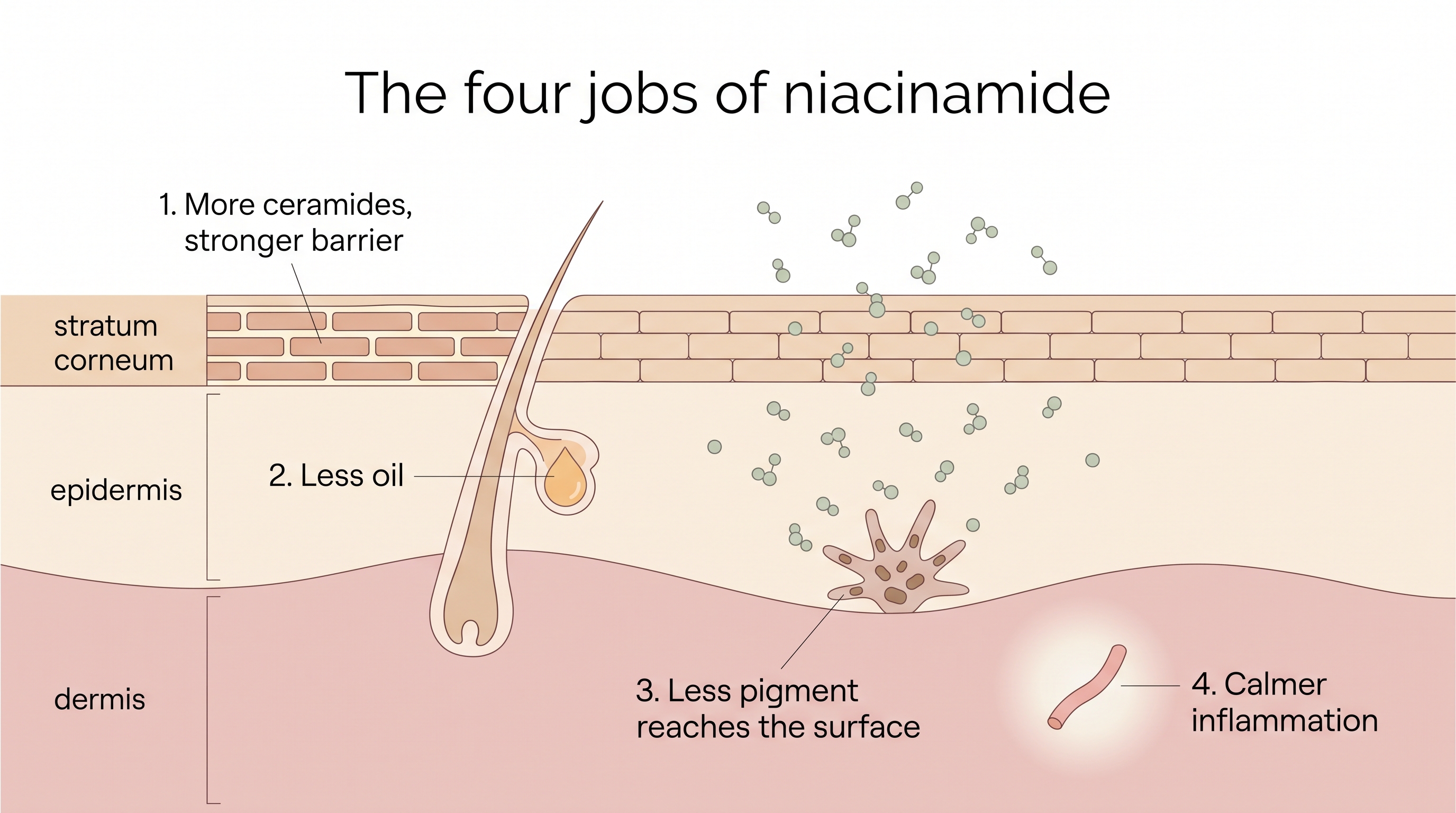
In everyday language, I like to think of it as doing four jobs for your skin: it helps your skin build its own barrier, it helps to calm down oil production, it stops pigment from reaching the surface of your skin, and it calms inflammation and redness. Depending on what your skin struggles with, one of those jobs will matter more to you than the others.
Which skin types it helps, and how
Dry, dehydrated or damaged skin
This is the one I find the most interesting, because it is not a moisturiser in the classic sense. Niacinamide does not just sit on top of your skin to keep the water in. It actually helps your skin make more of its own fats.
Your skin barrier is often explained as a brick wall, where the skin cells are the bricks and fats like ceramides are the mortar in between. In a study by Tanno and colleagues, skin cells that were treated with niacinamide made four to five times more ceramides, and also more free fatty acids and cholesterol. When they then put niacinamide on dry skin, the levels of ceramides and fatty acids in the outer skin layer went up and the skin lost less water (Tanno et al., 2000).
What I really like is a small study on people with atopic dermatitis, where they put a 2% niacinamide cream on one forearm and plain petrolatum (vaseline) on the other for several weeks. The niacinamide side lost less water and was better hydrated, while the petrolatum side did not reduce water loss at all (Soma et al., 2005). That is quite something, because petrolatum is one of the most classic ingredients to protect very dry skin. It was a small study, so I would not throw away your rich creams, but it shows that niacinamide works on the barrier from the inside rather than only covering it up.
Oily and acne-prone skin
If you have oily skin, niacinamide is probably the gentlest thing you can add. In a study with 100 Japanese people, a moisturiser with 2% niacinamide lowered the amount of oil the skin produced after two and four weeks compared to a placebo. In a smaller group of Caucasian people the result was a bit different: the amount of oil sitting on the skin went down, but the production rate itself did not change significantly (Draelos et al., 2006). So the effect is real but not huge, and it might differ a bit from person to person.
For actual breakouts, there is an older but still very nice study where a 4% niacinamide gel was compared to a 1% clindamycin gel, which is an antibiotic that dermatologists prescribe for acne. After eight weeks, both worked about equally well: 82% of the people on niacinamide improved, compared to 68% on the antibiotic (Shalita et al., 1995). The difference between the two was not statistically significant, so you cannot say niacinamide was better, but the fact that a vitamin can keep up with an antibiotic gel is pretty impressive. And niacinamide does not come with the risk of bacteria becoming resistant, which is a real worry with antibiotics.
I wish someone had told me this when I was a teenager trying every harsh acne product I could find. Niacinamide does not dry your skin out while it works on your breakouts, which is exactly what oily, acne-prone skin needs (see my hyaluronic acid post for why drying out acne skin backfires).
Red, reactive and rosacea-prone skin
Because niacinamide supports the barrier and calms inflammation, it is also one of the actives that people with redness and rosacea often tolerate well. In a study with 50 people with rosacea, a moisturiser containing niacinamide improved their skin barrier and hydration over four weeks, and the dermatologist saw their rosacea improve (Draelos et al., 2005). It was a whole moisturiser being tested and not niacinamide alone, so I see it as a good sign rather than hard proof. But it fits with everything else we know about it.
If your skin is very reactive, this is the group where I would be most careful with high percentages, and I will come back to that in the concentration part below.
Dark spots, post-acne marks and melasma
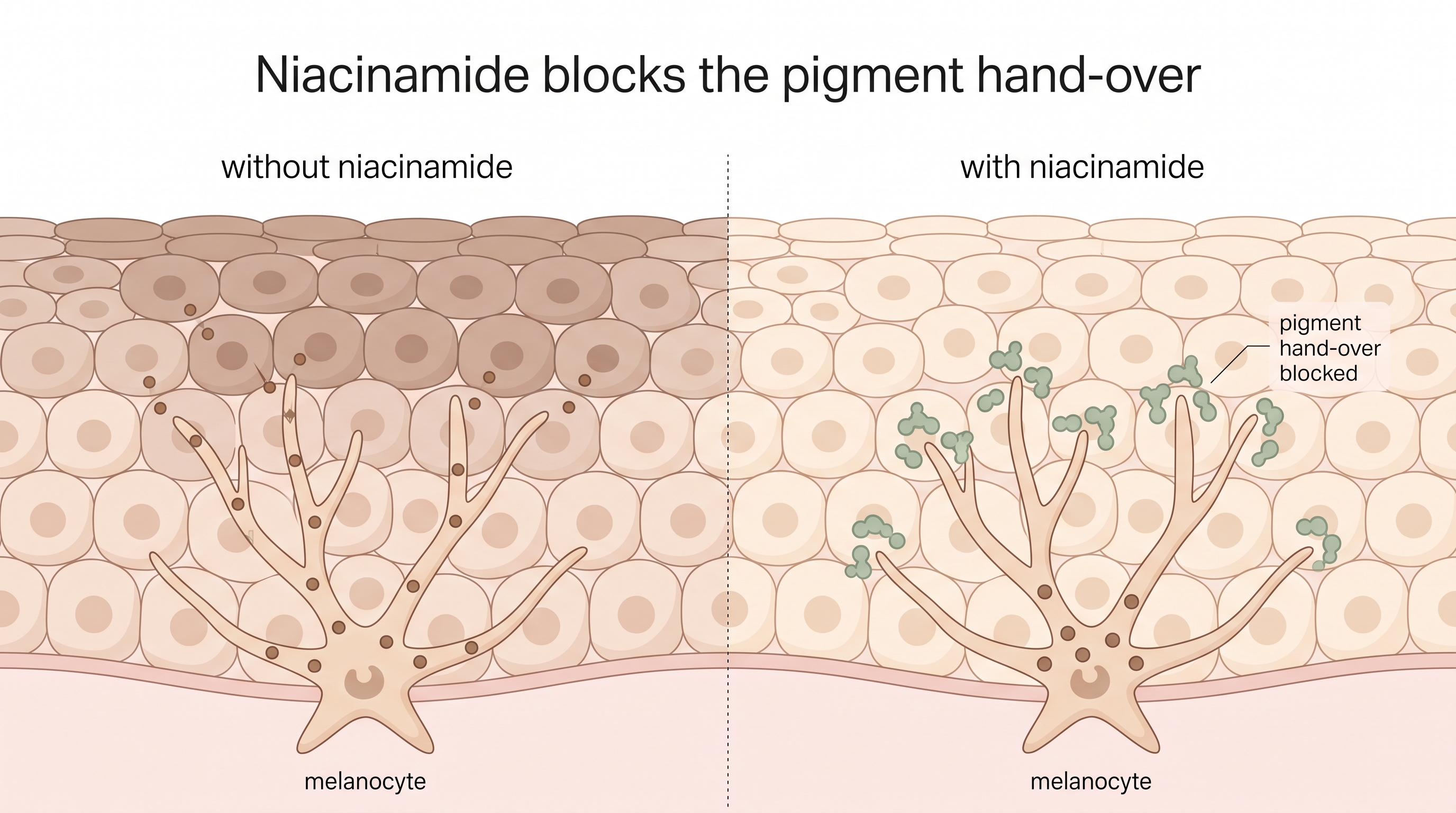
This is where niacinamide works in a really clever way. Your pigment (melanin) is made in cells called melanocytes, which sit at the bottom of your epidermis. They pack the pigment into little packages called melanosomes and then hand them over to the skin cells around them, which carry the colour up to the surface.
Most brightening ingredients, like vitamin C, try to slow down the production of pigment. Niacinamide does not do that at all. Instead, it blocks the hand-over. In lab models it reduced the transfer of pigment packages by 35% to 68%, and in the clinical part of the same study, a 5% niacinamide moisturiser reduced dark spots after four weeks compared to the same moisturiser without niacinamide, while 2% niacinamide with sunscreen made tanned skin lighter than sunscreen alone (Hakozaki et al., 2002).
For melasma, which is a very stubborn type of pigmentation, there is a study where people put 4% niacinamide on one side of their face and 4% hydroquinone on the other, for eight weeks. Hydroquinone is the classic prescription ingredient for pigmentation, and it can be quite irritating. Both sides improved, and when they measured skin colour there was no statistical difference between the two. Hydroquinone gave a good to excellent result in slightly more people (55% versus 44%), but niacinamide gave fewer side effects (18% versus 29%) (Navarrete-Solís et al., 2011). Everyone used sunscreen during the study, and that is important, because no brightening ingredient can keep up with daily sun exposure (see my sunscreen post).
And because niacinamide works on a different step than vitamin C, they actually make a great team. That is one of the reasons I always say you do not need to choose between them.
Aging skin
Niacinamide is also one of the better-studied gentle options for signs of aging. In a study with 50 women with sun-damaged skin, they used 5% niacinamide on one half of their face and a cream without it on the other half, twice a day for twelve weeks. The niacinamide side had fewer fine lines and wrinkles, fewer dark spots, less red blotchiness, less of that yellowish tone that skin can get with age, and better elasticity (Bissett et al., 2005). A Japanese study with a 4% niacinamide product around the eyes also found a clear improvement in wrinkles after eight weeks, and only one person out of 30 stopped because of minimal irritation (Kawada et al., 2008).
I do want to be honest here: a lot of the classic niacinamide studies (the ones by Bissett and Hakozaki included) were done by researchers working for a big skincare company that sells niacinamide products. That does not make the results wrong, and independent studies like the melasma and acne ones point in the same direction, but it is always good to know who paid for the research.
It is not as strong as retinol for wrinkles, and I would never tell you that it is. But if retinol is too much for your skin, niacinamide is a very reasonable place to start, and you will get other benefits along the way.
Here is everything from this part in one overview:
Concentration: the one thing people do get wrong
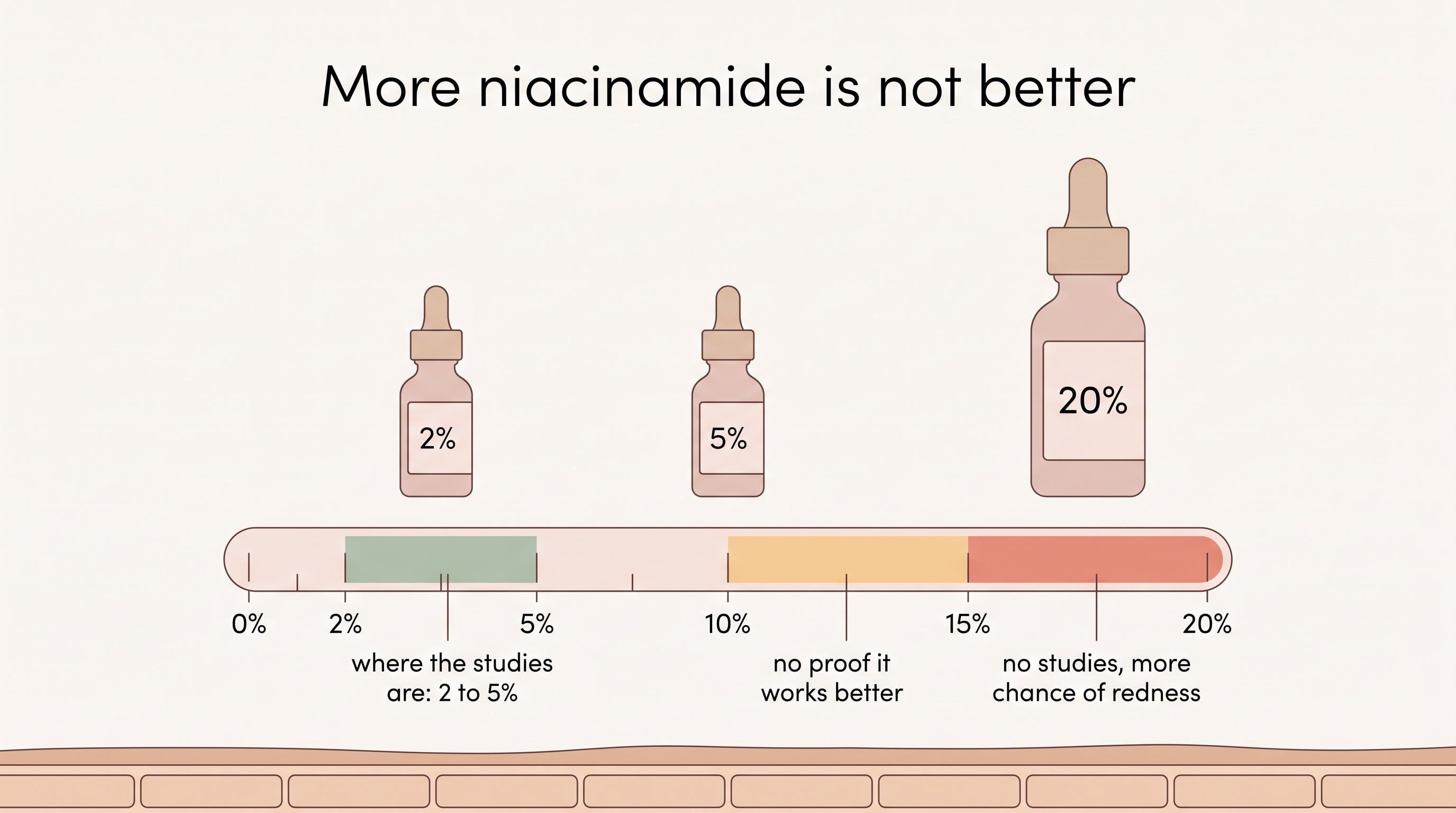
Now look at the last column of that table again. Every single study I just talked about used somewhere between 2% and 5% niacinamide. And then walk into any shop or scroll through any website, and you will see serums with 10%, 15% and even 20% niacinamide, often sold as the "stronger" version.
Here is the thing: I could not find one clinical study that shows 10% or 20% niacinamide works better than 5%. The higher numbers mostly come from marketing, because a bigger number on the bottle simply looks more powerful. It is the same trap we saw with acids in my acids post, where more is not automatically better.
What we do know about safety comes from the Cosmetic Ingredient Review, the expert panel that checks cosmetic ingredients in the US. In their safety report, niacinamide caused no stinging in tests up to 10%, and no irritation in use tests and a 21-day repeated test up to 5%. It was also not an allergen and did not make skin sensitive to light (Cosmetic Ingredient Review, 2005). So up to 5% it has been properly tested and is very gentle. Above that, there is simply much less data, both for the benefits and for the irritation.
And that matches what a lot of people experience in real life. Plenty of people use a 10% serum without any problem, but if you look around online you will find quite a few people who got redness, itching or little bumps from a high-percentage niacinamide product, while they never had issues with a 2% to 5% one. In the Japanese wrinkle study at 4%, only one person out of 30 had (minimal) irritation (Kawada et al., 2008). So if niacinamide has ever made your skin red, before you decide it is not for you, check the percentage first. In a lot of cases the ingredient is fine, but the dose was just higher than your skin needed.
One more thing to remember is that niacinamide is in a lot of products without being the main star. Your moisturiser, your sunscreen and your toner might all contain some. If you then add a 10% serum on top, you can end up with quite a lot on your face without realising it. That is usually not dangerous, but if your skin starts to react, that is the first thing I would look at.
So this is how I would think about it:
Why it plays nicely with almost everything
This is the second big reason I love recommending it. Niacinamide doesn't need a special low pH like L-ascorbic acid does, it does not exfoliate, and it does not make your skin more sensitive to the sun (Cosmetic Ingredient Review, 2005). That means it hardly ever clashes with other actives, and it can even make the harsher ones easier to live with.
With vitamin C. You have probably read somewhere that you cannot use niacinamide and vitamin C together. That idea comes from very old lab work at high temperatures and doesn't apply to how you actually use skincare at home. I already busted this myth in my vitamin C post and my post on combining actives, so I will not repeat it all here. You can use them together, and since they work on pigment in two different ways, they are actually a really good pair.
With retinol. This is a combination I really like for anyone who wants to start retinol but is scared of the irritation. In a study with 196 women, a routine with niacinamide, peptides and a gentle retinoid (retinyl propionate) was compared to the prescription retinoid tretinoin. The niacinamide routine improved wrinkles just as well after 24 weeks and was much better tolerated, with less redness, dryness and barrier damage (Fu et al., 2010). It was a whole routine and not niacinamide on its own, so I would not give all the credit to niacinamide. But it does show that a gentle, barrier-friendly routine can get you surprisingly far.
With acids and benzoyl peroxide. These are fine too. Niacinamide is often used next to salicylic acid or benzoyl peroxide in acne routines, because it helps to calm the skin while the other ingredient does the harsher work.
And that is really my whole point about why I prefer it over retinol and vitamin C as a first step. Retinol needs a slow build-up and can make your skin peel. L-ascorbic acid needs a very low pH to work, which is exactly what makes it sting on sensitive skin, and it breaks down easily once you open the bottle. Niacinamide doesn't ask for any of that, so you just put it on, morning or evening or both, and you can mostly forget about it.
What about taking it as a supplement?
I'll keep this one short, but people do ask me about it. There is a well-known study where people with a history of skin cancer took 500 mg of oral nicotinamide twice a day for a year. They developed 23% fewer new non-melanoma skin cancers than the placebo group, and the effect disappeared when they stopped taking it (Chen et al., 2015). That is a really interesting result, but it was a medical study in high-risk patients, and it is not about glowing skin. If you think this might be relevant for you, that is a conversation for your dermatologist, not for a beauty supplement aisle. For everything I talked about in this post, the topical version is the one with the evidence.
Niacinamide products I would actually look at
Because niacinamide is so popular, there are honestly hundreds of products with it, and a lot of the good ones come from K-beauty brands. I went through the ingredient lists of some of the best-known ones, and I sorted them by what we just learned about concentration, so you can see quickly which ones sit in the range the studies used and which ones go higher. And as always, the best product is the one your skin is happy with.
In the 2% to 5% sweet spot
The Ordinary Niacinamide 5% Face and Body Emulsion. This is the one I would recommend first if you want to stay with The Ordinary. It has 5% niacinamide, which is exactly the range from the studies, in a light lotion instead of a watery serum, so it already moisturises a bit and you can also use it on your neck, chest and arms. It is fragrance-free, and niacinamide is the third ingredient on the list.
SKIN1004 Madagascar Centella Tone Brightening Capsule Ampoule. SKIN1004 is a K-beauty brand with a few niacinamide products, and this is the one I would pick first. It has 4% niacinamide together with 2% tranexamic acid, which is another gentle ingredient for dark spots, and centella asiatica, which is calming. Because niacinamide and tranexamic acid work on pigment in different ways, this is a really nice option if dark spots or post-acne marks are your main worry. It is fragrance-free and suitable for sensitive skin.
Beauty of Joseon Glow Serum: Propolis + Niacinamide. This one has 2% niacinamide, so it is on the gentle side, which makes it a good first niacinamide product. The base is propolis extract, and it also contains a little tea tree extract and betaine salicylate (a mild relative of salicylic acid), so I see it mostly as a serum for oily and acne-prone skin. If you know you react to propolis or bee products, skip this one.
AXIS-Y Dark Spot Correcting Glow Serum. This K-beauty serum has niacinamide as the third ingredient, right after water and glycerin, together with hyaluronic acid and squalane. The brand does not give a percentage, but with niacinamide that high on the list, it very likely contains a useful amount. One thing to know: at the very end of the list there is rosemary leaf oil, which gives a light scent, so if your skin is very reactive to fragrance or essential oils, keep that in mind.
The higher-percentage ones
The Ordinary Niacinamide 10% + Zinc 1%. This is probably the most famous niacinamide serum in the world, and it is cheap, which is a big part of why everyone has tried it. It works fine for a lot of people, especially with oily skin. But it is 10%, which is double what the studies used, and if niacinamide has ever made your skin red or itchy, there is a good chance it was this kind of product. If that sounds like you, try their 5% emulsion instead before you give up on niacinamide.
SKIN1004 Madagascar Centella Niacinamide 10 Boosting Shot Ampoule. This one has 10% niacinamide, plus tranexamic acid, a stable vitamin C derivative (ascorbyl glucoside), centella and panthenol. It is a nicely built, fragrance-free formula, so if your skin likes higher percentages, this is a good one. If you are sensitive, I would pick the 4% capsule ampoule from the same brand.
COSRX The Niacinamide 15 Serum. COSRX is a very popular K-beauty brand, and the formula itself is short and simple, with niacinamide and zinc PCA for oily skin. But 15% is well above anything that has been tested in studies, so I would not choose this one just because the number is bigger. If you have oily skin that tolerates everything, you can try it, but there is no proof it will do more than a 5% product.
Here they are side by side:
Brands do change their formulas from time to time, so it is always worth checking the ingredient list on the box before you buy.
What to look for on the label
A few simple things to keep in mind when you are shopping:
- On the ingredient list (INCI), it is simply called Niacinamide (wow for once this is easy ;)).
- Look for a product that tells you the percentage, and aim for somewhere between 2% and 5%. If your skin is sensitive, start at the lower end.
- If a product does not mention a percentage but has niacinamide quite high in the ingredient list, it probably contains a useful amount.
- A niacinamide product that also contains barrier ingredients, like ceramides, glycerin or panthenol, is a really nice combination for dry or reactive skin.
- Check your other products before adding a separate niacinamide serum, so you do not end up stacking three products with it.
OK Emma great, now what's the actual takeaway?
If you are looking for one active that suits almost any skin, niacinamide is the one I would recommend first. It helps your skin build its own barrier, calms oil and breakouts, reduces redness, fades dark spots by stopping pigment from reaching the surface, and softens signs of aging, all while being very gentle.
The only real thing to pay attention to is the percentage. The studies used 2% to 5%, and that is where you will get the benefits with the lowest chance of irritation. You do not need 10% or 20%, and if your skin ever got red from a niacinamide product, check the percentage before you give up on it.
And because it gets along with vitamin C, retinol, acids and pretty much everything else, you can add it to the routine you already have without having to rethink the whole thing. Just don't forget your sunscreen, because without it, none of this will get you very far.
Welcome to Skinsights. I dive in the science behind skincare so you don't have to.
Scientific References
- Wohlrab J, Kreft D. "Niacinamide - mechanisms of action and its topical use in dermatology." Skin Pharmacol Physiol. 2014;27(6):311-5. DOI
- Boo YC. "Mechanistic basis and clinical evidence for the applications of nicotinamide (niacinamide) to control skin aging and pigmentation." Antioxidants (Basel). 2021;10(8):1315. DOI
- Ong RR, Goh CF. "Niacinamide: a review on dermal delivery strategies and clinical evidence." Drug Deliv Transl Res. 2024;14(12):3512-3548. DOI
- Tanno O, et al. "Nicotinamide increases biosynthesis of ceramides as well as other stratum corneum lipids to improve the epidermal permeability barrier." Br J Dermatol. 2000;143(3):524-31. DOI
- Soma Y, et al. "Moisturizing effects of topical nicotinamide on atopic dry skin." Int J Dermatol. 2005;44(3):197-202. DOI
- Draelos ZD, Matsubara A, Smiles K. "The effect of 2% niacinamide on facial sebum production." J Cosmet Laser Ther. 2006;8(2):96-101. DOI
- Shalita AR, et al. "Topical nicotinamide compared with clindamycin gel in the treatment of inflammatory acne vulgaris." Int J Dermatol. 1995;34(6):434-7. DOI
- Draelos ZD, Ertel K, Berge C. "Niacinamide-containing facial moisturizer improves skin barrier and benefits subjects with rosacea." Cutis. 2005;76(2):135-41. PubMed
- Hakozaki T, et al. "The effect of niacinamide on reducing cutaneous pigmentation and suppression of melanosome transfer." Br J Dermatol. 2002;147(1):20-31. DOI
- Navarrete-Solís J, et al. "A double-blind, randomized clinical trial of niacinamide 4% versus hydroquinone 4% in the treatment of melasma." Dermatol Res Pract. 2011;2011:379173. DOI
- Bissett DL, Oblong JE, Berge CA. "Niacinamide: a B vitamin that improves aging facial skin appearance." Dermatol Surg. 2005;31(7 Pt 2):860-5. DOI
- Kawada A, et al. "Evaluation of anti-wrinkle effects of a novel cosmetic containing niacinamide." J Dermatol. 2008;35(10):637-42. DOI
- Cosmetic Ingredient Review Expert Panel. "Final report of the safety assessment of niacinamide and niacin." Int J Toxicol. 2005;24 Suppl 5:1-31. DOI
- Fu JJJ, et al. "A randomized, controlled comparative study of the wrinkle reduction benefits of a cosmetic niacinamide/peptide/retinyl propionate product regimen vs. a prescription 0.02% tretinoin product regimen." Br J Dermatol. 2010;162(3):647-54. DOI
- Chen AC, et al. "A phase 3 randomized trial of nicotinamide for skin-cancer chemoprevention." N Engl J Med. 2015;373(17):1618-26. DOI