Retinol: let's figure out if you actually need it, and how to start without wrecking your skin.

My personal story with retinol
I started using retinol when I was around 16.
People usually react to that with something between confusion and mild horror. Sixteen? Retinol? The anti-wrinkle ingredient. What exactly was I trying to reverse at sixteen?
Nothing, I was using it for acne.
And that is the thing: vitamin A was an acne drug long before it became an anti-ageing hero. The wrinkle benefit was basically discovered by accident, because dermatologists kept noticing that their acne patients' skin also looked smoother and more even. Today I am still on a retinoid, but a prescription one: Differin 0.1%, which is adapalene, for hormonal acne. So this is not a post written by someone who thinks retinoids are scary. I have used them for most of my life.
It is a post written by someone who has watched a lot of people buy a 1% retinol serum because a video told them to, layer it on top of their vitamin C and their glycolic toner, and then wonder why their face is peeling off six days later.
Because here is the real problem with retinol: It is not that it is dangerous. It is that it does not fit into your routine. Your routine has to change around it.
Retinol is not one ingredient, but a whole family
When people say "retinol", they usually mean "the vitamin A thing". But vitamin A comes in several forms, and they are genuinely different in strength, not just in marketing.
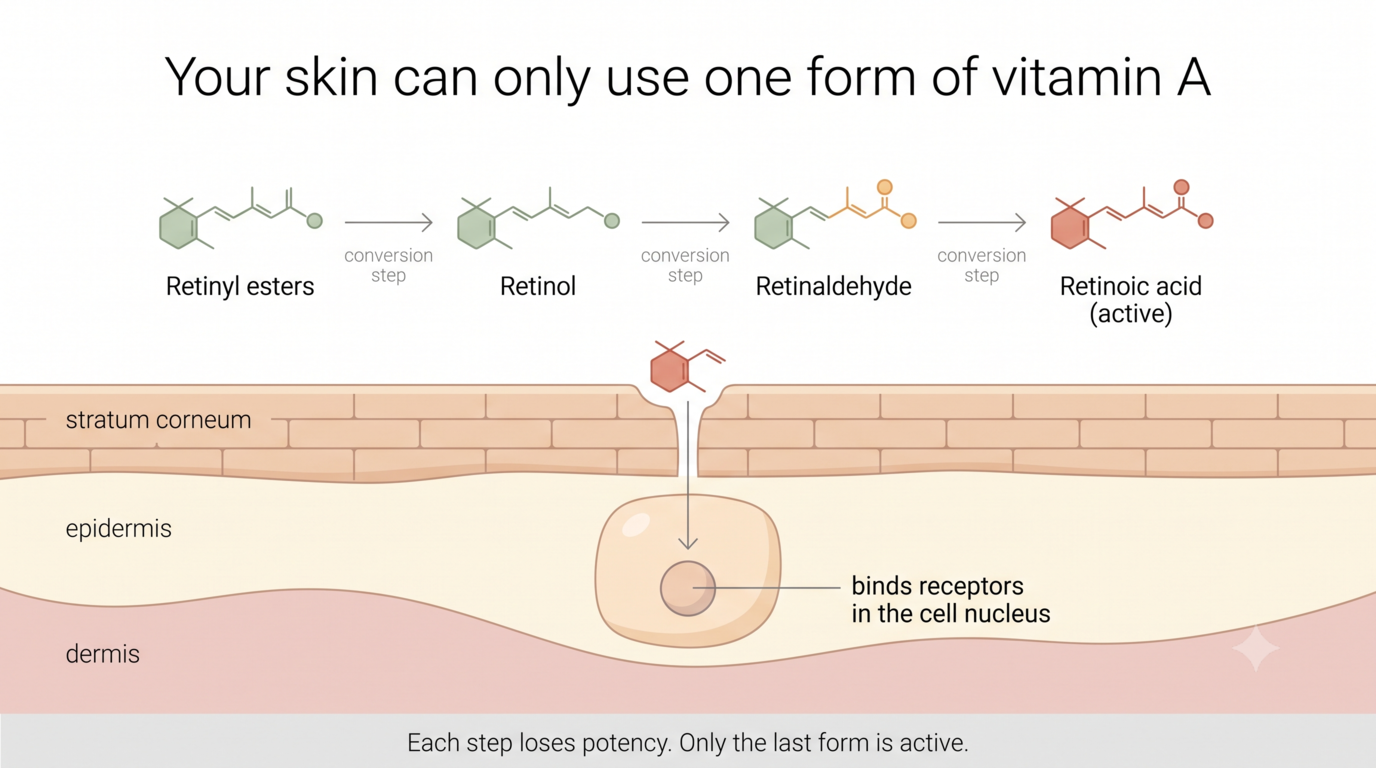
Your skin can only actually use one form: retinoic acid. That is the molecule that binds to receptors inside your skin cells and switches on the changes you want. Everything else you buy is a precursor that your skin has to convert into retinoic acid first. And every conversion step loses you potency.
The cascade goes like this: retinyl esters become retinol, retinol becomes retinaldehyde, retinaldehyde becomes retinoic acid. So retinol is two steps away from the active form. Retinaldehyde is one step away. Tretinoin is the active form, which is why it needs a prescription.
This is not theory, it has been measured in human skin. Duell and colleagues (1997) compared how much of each form you need to trigger the same biological response, and the gap is big: about 0.01% retinaldehyde, 0.025% retinol, and a whopping 0.6% retinyl palmitate. (DOI) So a product boasting about its retinyl palmitate is not really comparable to a retinol product, no matter what the front of the box says.
Here is the whole family in one table:
A quick honest note on HPR, because it is everywhere right now under the name "granactive retinoid". Brands describe it as a retinoid that works without conversion. The problem is that there is no published, placebo-controlled trial of HPR on its own in humans. Every study I could find tests it inside a formula with three or four other actives, so you cannot tell what the HPR is actually doing. What is well documented is that it is unusually stable in real cosmetic products, which is a genuine formulation advantage (DOI). Stable is not the same as strong. I would not treat HPR as a proven equivalent of retinol, and I would not pay extra for it.
What a retinoid actually does inside your skin
Once retinoic acid is present in the cell, it binds to receptors in the nucleus (the retinoic acid receptors) and changes which genes get read. That sounds abstract, so here is what it looks like in practice.
It speeds up cell turnover. Keratinocytes divide faster and move up through the epidermis quicker. Dead cells stop piling up in the pore opening, which is exactly why retinoids work for acne. Blocked pores are the very first step of a breakout, before bacteria and inflammation even get involved.
It rebuilds collagen. This is the anti-ageing part and it is properly evidenced. Griffiths and colleagues (1993) took biopsies from photodamaged skin after 10 to 12 months of tretinoin and found genuine restoration of type I collagen formation in the upper dermis (DOI). This is one of the few skincare ingredients where we have actual biopsy evidence, not just photographs.
It evens out pigment. Retinoids reduce melanin in the epidermis and speed up the shedding of pigmented cells, which is why they help with post-acne marks and sun spots.
Retinaldehyde specifically also kills acne bacteria. This one surprised me. Pechère and colleagues (1999) found that retinaldehyde is directly antibacterial against Cutibacterium acnes at low concentrations, while retinoic acid basically is not. In their small human study, 0.05% retinaldehyde cut the bacterial load on skin by around 2 logs in two weeks (DOI). So if you are choosing a retinoid mainly for breakouts, retinal is an interesting pick for reasons that have nothing to do with strength.
The part nobody puts on the packaging: it weakens your barrier first
This is the section I really want you to read, because it explains almost every retinol disaster I have seen.
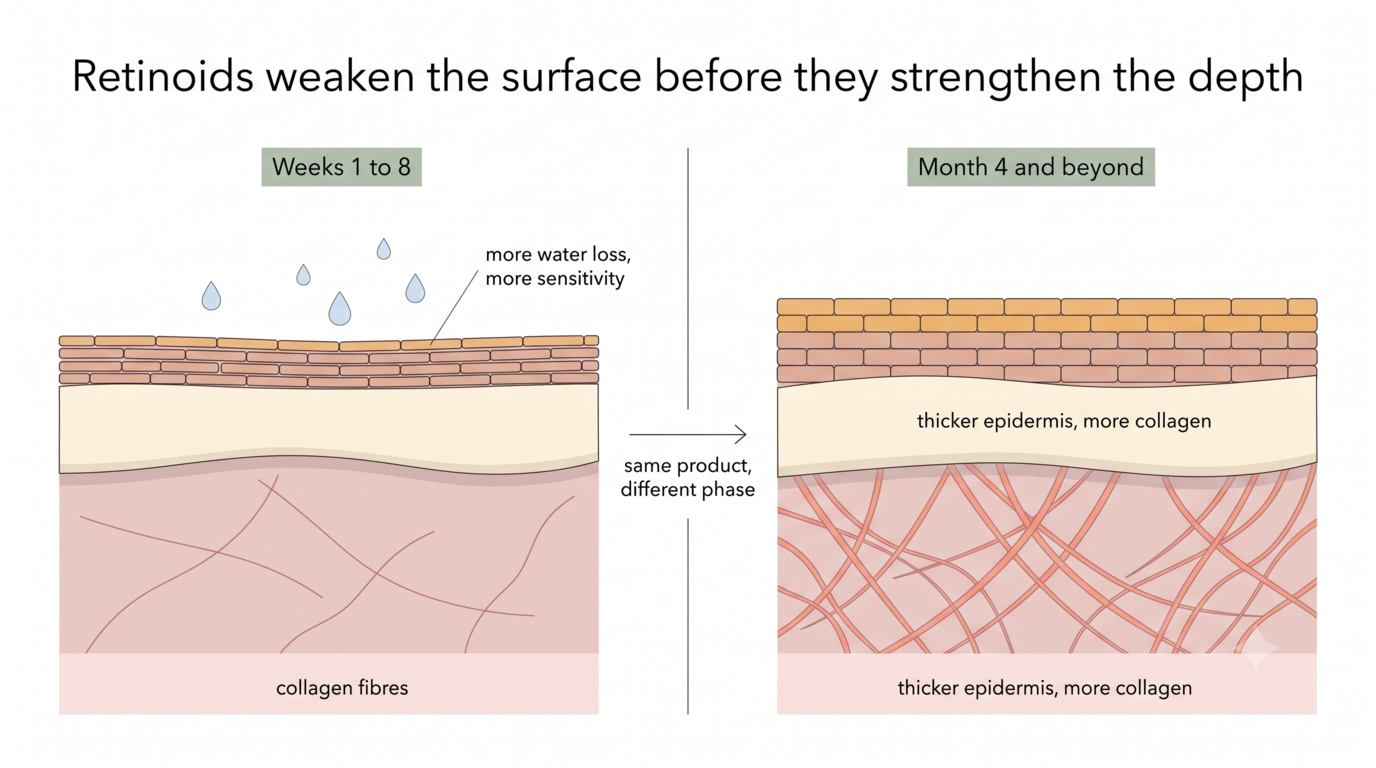
A retinoid makes the living layers of your skin thicker and healthier over months. The epidermis thickens, the dermis gets more collagen. That is the goal. But on the way there, it does something to the very top layer, the stratum corneum, that is the exact opposite.
The stratum corneum is your barrier. It is the flat brick wall of dead cells and lipids that keeps water in and irritants out. Retinoids compact and thin it. Elias (1986) described this pattern in detail: acanthosis and hypergranulosis in the living epidermis, together with a relative decrease in stratum corneum thickness (DOI). Kligman and colleagues, in the same year, reported increased transepidermal water loss alongside the epidermal renewal (DOI).
And it has been measured properly. Jacobson and colleagues (2007) found that three months of retinoic acid therapy on the face produced roughly a 25% thinner stratum corneum and about a 45% increase in transepidermal water loss compared to baseline (DOI). Transepidermal water loss is basically a barrier leak measurement. Higher number, leakier barrier.
A retinoid makes your skin thinner and more reactive at the surface, even while it is improving everything underneath. And a leakier barrier means everything else you apply penetrates more, stings more, and irritates more.
That is why "I'll just add retinol to my routine" is the wrong mental model. You are not adding an ingredient. You are temporarily changing how permeable your face is.
Retinization, and the numbers behind the ugly weeks
The irritation phase has a name: retinization. Redness, tightness, flaking, sometimes a wave of breakouts. It is not an allergy and it is not your skin "detoxing" (that is not a thing).
How common is it? Fluhr and colleagues (1999) followed 355 people and recorded, in the first four weeks of retinoic acid, redness in 44%, scaling in 35%, and burning or itching in 29%. Retinaldehyde and retinol were significantly better tolerated (DOI). So close to half of people on the strongest form get visible redness early. That is normal, not a sign you picked the wrong product.
The good news is that it settles. In a 22-month tretinoin study, Ellis and colleagues (1990) noted that the retinoid reaction diminished as treatment continued (DOI). But "it settles" is not a licence to power through anything. Peeling and tightness are expected. Raw, weeping, burning, swollen skin is not, and that is your signal to stop and rebuild.
So do you actually need a retinoid? A quick scorecard.
Before we talk about which one and how much, let's establish whether you need one at all. Go through these ten statements and count them honestly.
Section A. Reasons to say yes. Count one point for each that is true.
- I get regular breakouts, blackheads or closed comedones, and they are not just occasional.
- I have post-acne marks or sun spots that are not fading on their own.
- I can see fine lines that stay visible when my face is relaxed.
- My skin texture is rough or bumpy and good exfoliation has not fixed it.
- I am realistically going to use this consistently for at least six months.
- I already wear sunscreen every single day, without negotiating with myself about it.
Section B. Reasons to wait. Count one point for each that is true.
- My skin is currently red, tight, flaky, stinging or generally unhappy.
- I have eczema, rosacea or seborrhoeic dermatitis that is active right now.
- I am pregnant, trying to get pregnant, or breastfeeding.
- I am already using two or more actives (acids, vitamin C, benzoyl peroxide) and I do not want to give any of them up.
That last row matters. There is enormous pressure to be "on retinol" as if it were a milestone. It is a tool for specific problems. If you do not have those problems, all you are buying is the irritation.
Which retinoid, at which strength, for which skin
Now the useful part. Two rules first.
Rule one: start lower than you think. The evidence for going strong is genuinely underwhelming. Zasada and colleagues (2020) ran a split-face study comparing 0.3% and 0.5% retinol serums for 12 weeks. Both sides improved on wrinkles, pigmentation and unevenness. The 0.5% side had more frequent and more intense irritation (DOI). More retinol bought more side effects, not obviously more result.
Rule two: high strengths and prescription forms belong under dermatological supervision. I am not being precious about this. Tretinoin, tazarotene and adapalene are medicines. In Belgium and most of the EU, adapalene is prescription-only for a reason (in the US it happens to be over the counter). If your concern is acne severe enough to want a prescription retinoid, you want a dermatologist choosing it, not a comment section. And a 1% retinol as a first product is, in my opinion, just a bad idea.
One more practical note for anyone shopping in Europe. Since the EU updated Annex III of the Cosmetics Regulation in 2024, retinol, retinyl acetate and retinyl palmitate in cosmetics are capped at 0.3% retinol equivalent for face products and 0.05% for body lotion, with a "contains vitamin A" warning on the label (Commission Regulation (EU) 2024/996). So if you are in the EU, that 1% retinol serum you saw online is on its way off the shelves anyway.
On pregnancy, one nuance worth knowing so you do not panic if you already used some. A meta-analysis by Kaplan and colleagues (2015) covering 654 exposed pregnancies found no significant increase in major malformations after first-trimester topical retinoid exposure. The authors' own conclusion is the important bit: the data is reassuring if you were accidentally exposed, but not strong enough to justify deliberately using retinoids in pregnancy (DOI). So: do not start, do not panic, do ask your doctor.
How to build it up, week by week
Slow escalation is not just internet caution, it is the strategy that has actually been tested. Draelos and Peterson (2020) ran a 12-week study using escalating doses specifically as a method to reach retinization with less irritation (DOI).
Here is the schedule I would give a friend. Only move to the next stage when the current one feels boring (not mentally, but really physically; I'm also impatient, but please do this properly).
Three practical things that make a real difference:
- A pea. For the whole face. Not a pump, not a dropper. More product does not mean more collagen, it means more irritation.
- Dry skin, always. Applying a retinoid to damp skin increases penetration and irritation. Wait a few minutes after cleansing.
- Use a moisturiser alongside it. This one is evidenced. Schorr and colleagues (2012) ran a split-face study where everyone used tretinoin 0.05% and only one side got a ceramide-precursor moisturiser. The moisturised side had milder irritation (PubMed). Worth noting: most people were still irritated on both sides. Moisturiser reduces the severity, it does not cancel it.
You will also read about the "sandwich method", where you put moisturiser under the retinoid too. I want to be honest here: I could not find a single controlled study testing it. Not for irritation, not for whether it reduces the effect. It might well work. It is just untested, so treat it as a personal experiment rather than a rule.
Now the part everyone skips: what retinol does to the rest of your routine
This is why I wanted to write this post. Starting a retinoid is not an addition, it is a reorganisation. Some of what you were happily using before now has to go, at least for a while.
The one that is genuinely proven: benzoyl peroxide with tretinoin
If you use tretinoin, do not apply benzoyl peroxide at the same time. Martin and colleagues (1998) mixed them and exposed them to light, and tretinoin lost over half its content in about two hours and 95% by 24 hours. Adapalene, in the same experiment, was remarkably stable (DOI).
That adapalene exception is not a detail, it is the entire reason adapalene plus benzoyl peroxide fixed-combination gels exist as products. So: benzoyl peroxide and tretinoin, separate them (one morning, one evening). Benzoyl peroxide and adapalene, fine together.
Vitamin C, and every other sensitising active you own
This is where most people go wrong, and it has nothing to do with chemistry. It is about how much irritation your skin can absorb at once.
Remember that 45% increase in water loss. Everything you apply now goes in further, sits there longer, and stings more than it did a month ago. A product you tolerated perfectly well before you started your retinoid can suddenly feel like it is burning.
Pure L-ascorbic acid is the clearest example. It only works when it is formulated at a genuinely low pH, which is why a good vitamin C serum has a bit of a bite to it (DOI). On intact skin, that bite is nothing. On retinised skin, it is a lot. So move it: vitamin C in the morning, retinoid at night. You lose nothing by splitting them, and your face stays calm. (More on the different vitamin C forms in the vitamin C post.)
The same logic applies to anything else on the sensitising list: strong exfoliating toners, high-percentage vitamin C, benzoyl peroxide, essential oils, fragrance, alcohol-heavy formulas, even that mask you use "just once a week". None of them are individually evil. Stacked on a barrier that is already compromised, they add up fast, and the result is the exact opposite of what you started the retinoid for.
Acids: less forbidden than you think, still a bad idea while you are starting
The usual rule is "never combine acids and retinoids". I went looking for the study behind that and, honestly, it is thinner than expected. There is no controlled trial showing cumulative irritation from layering AHAs or BHAs with a retinoid. And there is one study pointing the other way: Kligman and Draelos (2016) applied retinol or tretinoin immediately after a 30% salicylic acid peel and found it was well tolerated (PubMed).
So why do I still say pause them? Because that study was done in a controlled clinical setting on people whose barrier was intact, with a professional deciding the doses. At home, during retinization, on a barrier that is measurably leakier, stacking two things that both accelerate shedding is how people end up with the face I had after my acids phase (that story is in the acids post).
Everything else
The real principle is simpler than any ingredient-pair chart: a retinoid uses up your skin's entire irritation budget. You do not have room for much else. This is the same "skin goal overlap" logic from the actives combinations post, except retinol raises the stakes because it changes how permeable your skin is.
About sun, because this one is more nuanced than you have been told
Two separate facts get mashed together here.
Fact one: retinoids break down in light. Tashtoush and colleagues (2008) showed UVA is the main driver of tretinoin photodegradation (DOI), and in real marketed cosmetics, light-driven degradation beat heat-driven degradation (DOI). This is the actual reason for "use it at night", and also why a retinol in a clear jar is a waste of money.
Fact two: does a retinoid make you burn faster? Less clearly than everyone says. Slade and colleagues (2009) pooled four controlled trials and found no phototoxic or photoallergic reactions with tretinoin 0.05%, concluding it appears to be neither (DOI). Product labels still carry a photosensitivity warning, and tazarotene's label does mention increased burning susceptibility.
My take: you still wear sunscreen daily, absolutely without exception. Not because the retinoid is a proven photosensitiser, but because your barrier is compromised, your skin is inflamed and reactive, and you are spending money and months building collagen that UV is actively tearing down. Undoing your own work is the real risk. (Everything on filters and how to choose one is in the sunscreen post.)
What your routine actually looks like now
Strip it back. Genuinely. This is the whole thing.
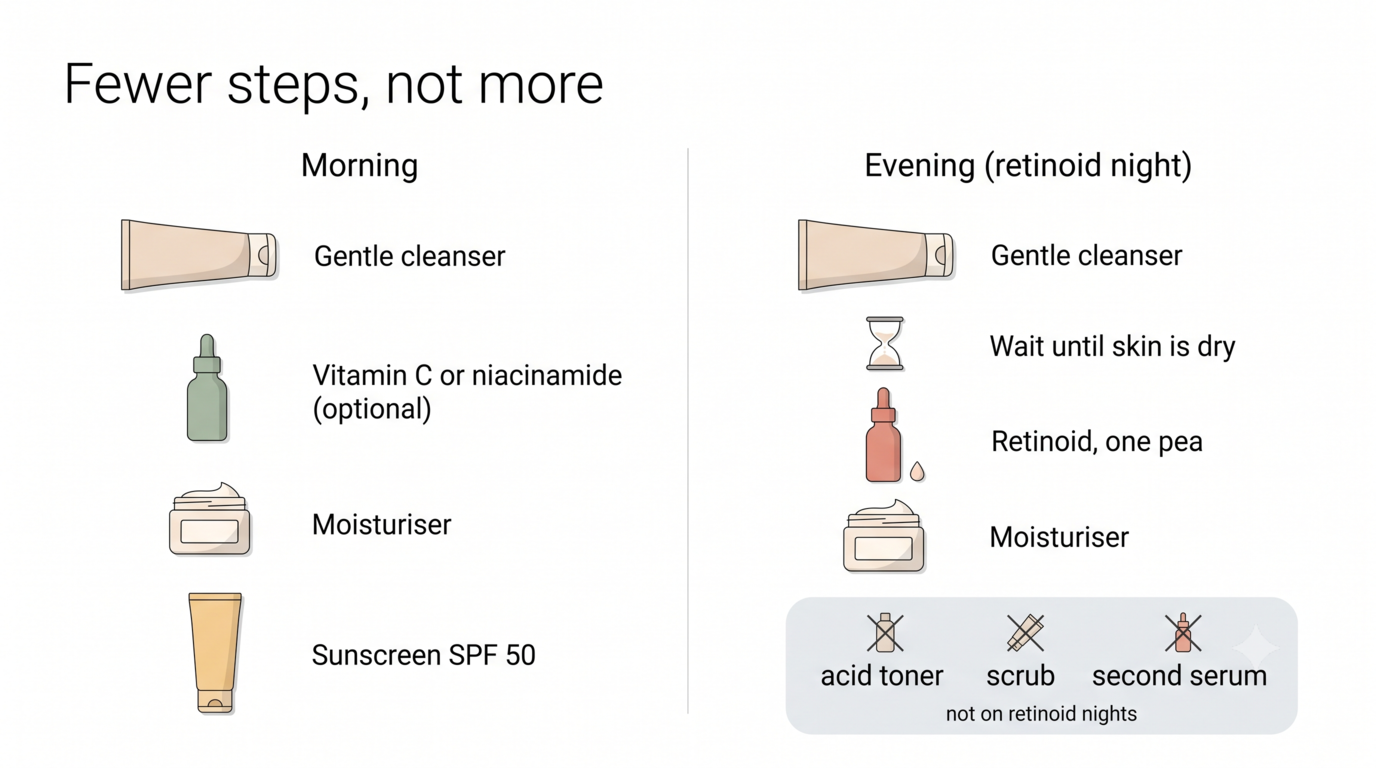
Morning: gentle cleanser (or just water), an optional vitamin C or niacinamide serum, moisturiser, sunscreen.
Evening, on retinoid nights: gentle cleanser, wait until skin is fully dry, a pea of retinoid, moisturiser on top. Nothing else. No toner, no acid, no second serum.
Evening, on off nights: gentle cleanser, hydrating serum if you want one, moisturiser. This is your recovery night.
If you look at that and think "but I have eight products", that is exactly the point. Cut down.
If retinol is not for you, you still have options
This is not a case of retinol or nothing.
Bakuchiol is the most interesting alternative, and it has a real head-to-head trial behind it. Dhaliwal and colleagues (2019) randomised 44 people to either bakuchiol 0.5% cream twice daily or retinol 0.5% cream once daily for 12 weeks. Both significantly reduced wrinkle surface area and hyperpigmentation, with no statistical difference between them. The retinol group reported more scaling and stinging (DOI).
That is a genuinely good result, and worth two caveats. It is one study with 44 people, so it is not the mountain of evidence retinoids have accumulated over 40 years. And bakuchiol is not chemically a retinoid at all, despite being sold as "plant retinol". It seems to switch on some of the same genes without binding the same receptors. But for sensitive skin, for pregnancy (after checking with your doctor), or for anyone who has tried retinol twice and hated it both times, it is a legitimate choice.
Retinaldehyde deserves repeating here as the middle path. Creidi and colleagues (1998) compared retinaldehyde 0.05% with retinoic acid 0.05% over 18 weeks in 125 people. Both significantly reduced wrinkles and roughness versus vehicle, but retinaldehyde was well tolerated throughout while retinoic acid caused more irritation and hurt compliance (DOI). If retinol has failed you on tolerance, retinal is often the better answer, not a lower retinol.
Niacinamide at 4% to 5% for barrier, sebum and pigment (DOI). Azelaic acid for redness, breakouts and pigment, and it is one of the few actives generally considered fine in pregnancy. Peptides for a slow, gentle nudge to collagen. None of these will match tretinoin. All of them will beat a retinoid you gave up on in week three.
Some products worth looking at
Not sponsored, not exhaustive, and please read the strength column rather than the brand name.
- Starting out, sensitive: Medik8 Crystal Retinal 1 (0.01% encapsulated retinaldehyde). The lowest strength of a proper retinal range, which makes stepping up simple later. It is also the one in the little violet bottle, if that is the one you were picturing.
- Starting out, budget: The Inkey List Starter Retinol Serum, which pairs encapsulated granactive retinoid with 0.01% retinal. Around 15 euro, and genuinely designed as a first product.
- Straightforward retinol, well formulated: La Roche-Posay Retinol B3 Serum. The UK and EU listing states 0.3% retinol, alongside niacinamide, which is a sensible pairing.
- The classic: Paula's Choice 1% Retinol Booster. It is a booster, which means you are meant to mix a few drops into your moisturiser rather than use it neat. Please actually do that, and please do not make it your first retinoid. Their CLINICAL 0.3% Retinol + 2% Bakuchiol Treatment is the more sensible starting point from the same brand.
- Stepping up on retinal: Medik8 Crystal Retinal 3, 6 and 10 (0.03%, 0.06%, 0.1%), or Avène Retrinal 0.05% and 0.1% creams.
- Bakuchiol: Medik8 Bakuchiol Peptides at 1.25%. The Inkey List used to make a bakuchiol moisturiser but their site now says they do not currently stock one, so check before you go looking.
- Minimalist retinol: The Ordinary Retinol 0.2% or 0.5% in Squalane. Cheap and simple. Skip the 1%, and be aware that their Granactive Retinoid products are the HPR I was sceptical about earlier.
- If it is really about acne: talk to a doctor about adapalene 0.1%. It is prescription in Belgium and most of Europe, over the counter in the US, and it is the one I have ended up on.
OK Emma great, now what's the actual takeaway?
Retinoids work. That part is not in question, and the evidence for them is stronger than for almost anything else you can buy. But most people fail with them for reasons that have nothing to do with the molecule.
Ask yourself first whether you actually have a problem a retinoid solves. If you scored zero in section A, you are allowed to skip this entirely.
If you do need one, start lower than the internet tells you, twice a week, a pea, at night, with moisturiser. Understand that your barrier gets measurably weaker before your skin gets better, and that this is temporary and normal.
And then actually change your routine around it. Pause your acids. Move your vitamin C to the morning. Put away the scrub. Keep your niacinamide, your ceramides and your sunscreen. The reason retinol "did not work" for so many people is almost never the retinol. It is the six other things they kept using next to it.
I have been on some form of vitamin A since I was 16, for acne rather than wrinkles, and the anti-ageing part has been a very slow bonus I did not ask for.
Welcome to Skinsights. I dive in the science behind skincare so you don't have to.
Scientific References
- Duell EA, Kang S, Voorhees JJ. "Unoccluded retinol penetrates human skin in vivo more effectively than unoccluded retinyl palmitate or retinoic acid." J Invest Dermatol. 1997;109(3):301-305. DOI
- Elias PM. "Epidermal effects of retinoids: supramolecular observations and clinical implications." J Am Acad Dermatol. 1986;15(4 Pt 2):797-809. DOI
- Kligman AM, Grove GL, Hirose R, Leyden JJ. "Topical tretinoin for photoaged skin." J Am Acad Dermatol. 1986;15(4 Pt 2):836-859. DOI
- Jacobson MK, Kim H, Coyle WR, et al. "Effect of myristyl nicotinate on retinoic acid therapy for facial photodamage." Exp Dermatol. 2007;16(11):927-935. DOI
- Griffiths CE, Russman AN, Majmudar G, Singer RS, Hamilton TA, Voorhees JJ. "Restoration of collagen formation in photodamaged human skin by tretinoin (retinoic acid)." N Engl J Med. 1993;329(8):530-535. DOI
- Pechère M, Pechère JC, Siegenthaler G, Germanier L, Saurat JH. "Antibacterial activity of retinaldehyde against Propionibacterium acnes." Dermatology. 1999;199(Suppl 1):29-31. DOI
- Fluhr JW, Vienne MP, Lauze C, Dupuy P, Gehring W, Gloor M. "Tolerance profile of retinol, retinaldehyde and retinoic acid under maximized and long-term clinical conditions." Dermatology. 1999;199(Suppl 1):57-60. DOI
- Ellis CN, Weiss JS, Hamilton TA, Headington JT, Zelickson AS, Voorhees JJ. "Sustained improvement with prolonged topical tretinoin (retinoic acid) for photoaged skin." J Am Acad Dermatol. 1990;23(4 Pt 1):629-637. DOI
- Zasada M, Budzisz E, Erkiert-Polguj A. "A clinical anti-ageing comparative study of 0.3 and 0.5% retinol serums: a clinically controlled trial." Skin Pharmacol Physiol. 2020;33(2):102-116. DOI
- Draelos ZD, Peterson RS. "A double-blind, comparative clinical study of newly formulated retinol serums vs tretinoin cream in escalating doses: a method for rapid retinization with minimized irritation." J Drugs Dermatol. 2020;19(6):625-631. DOI
- Schorr ES, Sidou F, Kerrouche N. "Adjunctive use of a facial moisturizer SPF 30 containing ceramide precursor improves tolerability of topical tretinoin 0.05%: a randomized, investigator-blinded, split-face study." J Drugs Dermatol. 2012;11(9):1104-1107. PubMed
- Martin B, Meunier C, Montels D, Watts O. "Chemical stability of adapalene and tretinoin when combined with benzoyl peroxide in presence and in absence of visible light and ultraviolet radiation." Br J Dermatol. 1998;139(Suppl 52):8-11. DOI
- Pinnell SR, Yang H, Omar M, et al. "Topical L-ascorbic acid: percutaneous absorption studies." Dermatol Surg. 2001;27(2):137-142. DOI
- Kligman DE, Draelos ZD. "Combination superficial peels with salicylic acid and post-peel retinoids." J Drugs Dermatol. 2016;15(4):442-450. PubMed
- Tashtoush BM, Jacobson EL, Jacobson MK. "UVA is the major contributor to the photodegradation of tretinoin and isotretinoin: implications for development of improved pharmaceutical formulations." Int J Pharm. 2008;352(1-2):123-128. DOI
- Slade HB, Shroot B, Feldman SR, Cargill DI, Stanfield J. "Reappraising the phototoxicity of tretinoin: a report of four controlled clinical trials." Photodermatol Photoimmunol Photomed. 2009;25(3):146-152. DOI
- Temova Rakuša Ž, Škufca P, Kristl A, Roškar R. "Retinoid stability and degradation kinetics in commercial cosmetic products." J Cosmet Dermatol. 2021;20(7):2350-2358. DOI
- Kaplan YC, Ozsarfati J, Etwel F, Nickel C, Nulman I, Koren G. "Pregnancy outcomes following first-trimester exposure to topical retinoids: a systematic review and meta-analysis." Br J Dermatol. 2015;173(5):1132-1141. DOI
- Dhaliwal S, Rybak I, Ellis SR, et al. "Prospective, randomized, double-blind assessment of topical bakuchiol and retinol for facial photoageing." Br J Dermatol. 2019;180(2):289-296. DOI
- Creidi P, Vienne MP, Ochonisky S, et al. "Profilometric evaluation of photodamage after topical retinaldehyde and retinoic acid treatment." J Am Acad Dermatol. 1998;39(6):960-965. DOI
- Wohlrab J, Kreft D. "Niacinamide: mechanisms of action and its topical use in dermatology." Skin Pharmacol Physiol. 2014;27(6):311-315. DOI
- European Commission. "Commission Regulation (EU) 2024/996 of 3 April 2024 amending Regulation (EC) No 1223/2009 as regards the use of Vitamin A, Alpha-Arbutin and Arbutin." EUR-Lex
.jpg)
%20(1).jpg)