Silicones in skin-and haircare. Why they are not (necessarily) the bad guys.

My personal story with silicones
Years ago I bought a conditioner. (I hear you thinking, wow Emma, amazing accomplishment. ;)) I knew nothing about haircare back then. I did not read labels, I did not know what a surfactant was, just wanted my hair to stop tangling and be soft.
And honestly, it worked. The first time I used it, my hair felt incredible. Soft, shiny, easy to comb. I remember thinking that this was what good hair was supposed to feel like.
Then, slowly, something shifted. Over a few months my hair got drier. Then it started feeling a bit like straw underneath all that softness, which is a weird combination if you have never had it. I blamed everything else: The heat styling? The winter? Hard water? My genes???
It took me a long time to learn that the problem was the thing I loved most about that conditioner. It was full of silicones.
Fast forward to today, and "silicone free" is printed on the front of half the bottles in the shop. It has become a badge, like "paraben free" before it. So imagine my confusion when I turned over my makeup primer, the one that makes my makeup sit beautifully all day, and found that it is basically silicone from top to bottom. Not one silicone. Five or six of them, taking up the first six lines of the ingredient list.
So which is it? Villain or hero? The answer turned out to be one of my favourite kinds of answer: it depends entirely on whether the thing you are putting it on is alive.
First, what a silicone actually is
People often lump silicones in with oils, or with plastics. They are neither.
An oil is built on a chain of carbon atoms. A silicone is built on a chain of silicon and oxygen atoms instead, with little methyl groups hanging off the sides. That backbone is the whole story. It is extremely flexible, extremely stable, it does not oxidise, it does not go rancid, bacteria do not eat it, and it does not react with your skin. It is one of the most chemically boring things you can put on your face, and in cosmetics boring is often a compliment.
The practical bit for you is that silicones are easy to spot on a label, because they nearly all end the same way. Look for -cone, -siloxane, -conol and -silane. Dimethicone, cyclopentasiloxane, dimethiconol, phenyl trimethicone, amodimethicone. Once you know the suffix you can never unsee them.
But they are not all the same, and this is where most of the internet gets sloppy. A volatile silicone and a heavy film-forming silicone behave completely differently. Here is the family:
The thing nobody told me: on skin, silicones do almost nothing
I assumed, like most people, that silicones work by sealing your skin. A layer of something waterproof on top, trapping moisture underneath, a bit like petrolatum does.
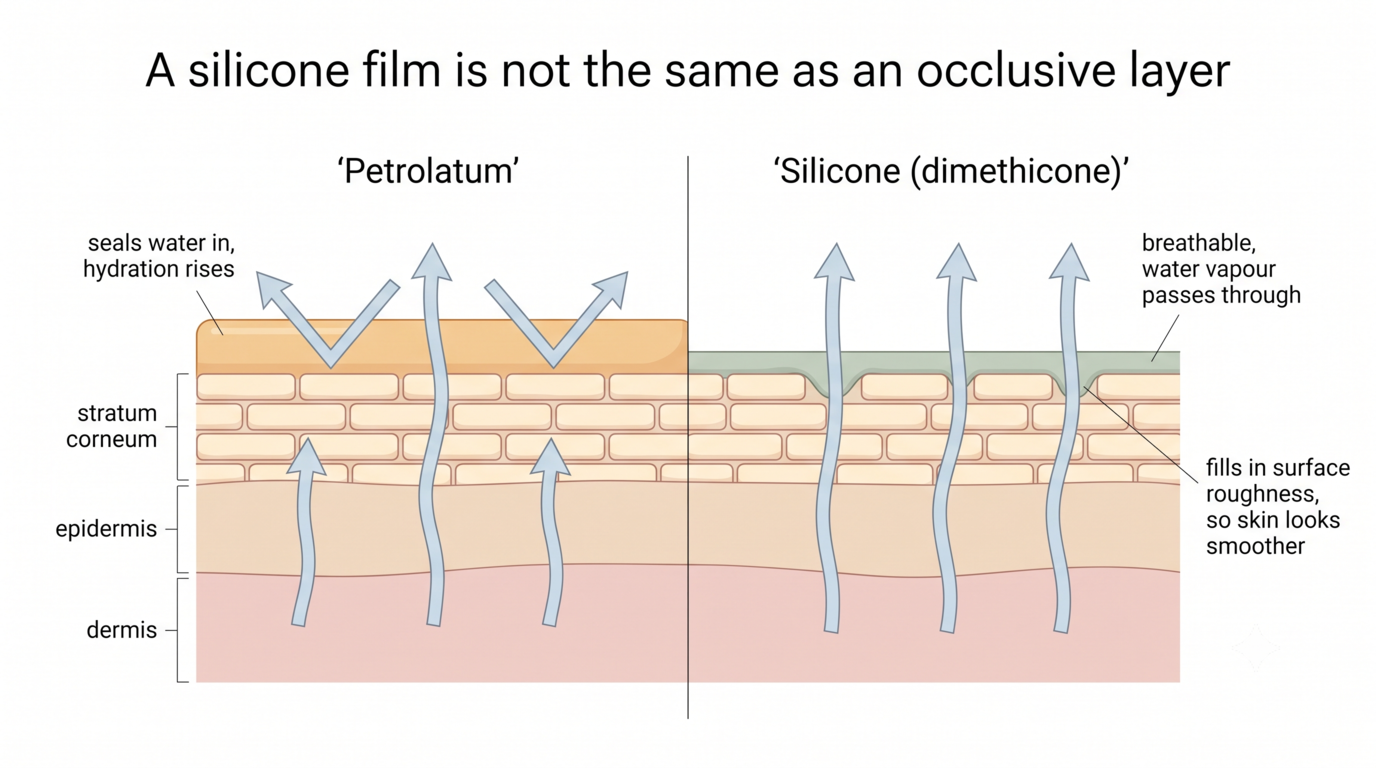
That is not what happens, and there is a lovely study that measured it. Researchers put common silicone ingredients on skin and compared them with petrolatum. Petrolatum did exactly what you expect: it formed an occlusive layer and pushed skin hydration up for more than four hours. The silicones did not. Their transepidermal water loss values were not significantly different from untreated skin, and they did not raise hydration either (DOI).
Silicones are not occlusive. The film they make is permeable to water vapour. It lets your skin breathe out, which is exactly why it never feels heavy or sweaty the way an ointment does.
And occlusion is the entire mechanism people are imagining when they picture a moisturiser "sealing" the skin. A real occlusive slows water escaping from the surface, water builds up underneath, and the stratum corneum plumps up (DOI). Petrolatum does that. Shea butter does a bit of it. Silicones do not. They belong to a different job description entirely: not occlusive, not humectant, but texture (DOI).
So if silicones do not seal, do not hydrate and do not penetrate, what on earth are they doing in your moisturiser?
They are doing something that sounds shallow but is not: they are making the product feel good and look good on you. A silicone film fills in the microscopic roughness of the stratum corneum, so light bounces off your face more evenly and your skin looks smoother the second you apply it. It cuts friction, so the cream glides instead of dragging. It stops a formula from feeling greasy or sticky. And it gives makeup something even to sit on instead of settling into every dry patch.
But do they clog pores?
This is the big one, so let me be direct. No.
A dimethicone molecule is a large, inert polymer. It sits on the surface of your skin, it does not travel down into a follicle, and it is not a lipid, so the things that live inside a pore cannot feed on it. That is a real difference from many plant oils and esters, which are made of exactly the fatty acids that skin bacteria and yeast happily eat.
The "comedogenic rating" charts that circulate online are also much weaker than people think. Those numbers mostly trace back to rabbit ear testing from the 1980s, on single raw ingredients, at concentrations nobody actually formulates at. Dermatologists have been saying for twenty years that they do not predict how a finished product behaves on a human face. A product made with a so-called comedogenic ingredient is often not comedogenic at all, and the reverse is also true (DOI, DOI).
Silicones themselves have one of the cleanest safety records in cosmetics. The Cosmetic Ingredient Review panel has assessed both the linear ones and the crosspolymer elastomers and concluded they are safe as used (DOI). They are also very low on the irritation and allergy scale, which is why you find dimethicone in barrier creams for nappy rash and in products aimed at people whose skin reacts to everything.
If you broke out after using a silicone-heavy product, I would bet on two other explanations before blaming the silicone. Either something else in the formula did it, or the product was so long-wearing that you did not remove it properly at night. A grippy silicone primer plus a full-coverage foundation plus a quick splash of water is not a cleanse.
So why is it in everything, if it does nothing?
Because "how a product feels" is not a vanity metric. It is one of the strongest predictors of whether you will actually use it.
This is very well documented in dermatology, where they have the same problem with prescription creams. Patients skip topical treatments constantly, and one of the biggest reasons is that they do not like how the vehicle feels on them. Reviews of adherence keep landing on the same conclusion: choose a texture the patient likes, and they use the product more consistently (DOI). Adherence to topical treatment is worse than to almost any other kind, and texture is a big part of why (DOI).
Now apply that to your own bathroom shelf. Think of the moisturiser you bought once and never repurchased because it felt like glue. Think of the sunscreen you skipped on a hot day because it was heavy and white and sticky. The best formula in the world does nothing sitting in a drawer.
Silicones are, in a sense, the compliance ingredient. They are what lets a formulator load a cream with the things that do work, ceramides, niacinamide, UV filters, and still have it feel light enough that you reach for it every single morning. That is a real benefit. It is just not the benefit people think they are buying.
There are a few places where they do more than feel nice:
- Makeup primers. Elastomers like dimethicone crosspolymer form a soft, springy, deformable film that sits over uneven texture and gives that velvety grip (DOI). There is genuinely no other ingredient class that does this as well, which is why silicone free primers behave so differently.
- Sunscreen. Silicones are a big part of why modern sunscreens are wearable at all. And a sunscreen you enjoy wearing is a sunscreen you apply properly, which matters far more than any other detail (see the Skinsights sunscreen post).
- Scars. Medical silicone gel and sheeting for raised and keloid scars is a real, first line treatment. The proposed mechanism is hydration of the stratum corneum over the scar, which quiets the signalling between keratinocytes and the fibroblasts that are overproducing collagen (DOI). Worth knowing that the evidence base is thinner than the popularity suggests: the Cochrane review found only low to very low certainty evidence (DOI). Note that this is thick medical grade silicone gel worn for hours, not a drop of dimethicone in a day cream. Different thing entirely.
- Barrier and protectant creams. Dimethicone is a recognised skin protectant, and it turns up in creams for irritated, chafed or medically compromised skin because it is so unreactive.
Which skin types actually get something out of them
This is the practical part. Silicones are not a hero ingredient for anybody, but they are more useful for some people than others.
The pattern is simple. If your complaint is feel, silicones help. If your complaint is dryness, silicones will trick you.
Day cream yes, night cream honestly optional
Here is my own rule, and I want to be clear about which part is science and which part is preference.
Everything silicones are genuinely good at is a daytime job. Smoothing the surface so makeup goes on evenly. Giving foundation something to grip. Making a sunscreen light enough that you actually put on a proper amount. Cutting the friction of a mask, a scarf, a phone screen against your cheek. All daytime.
At night, none of that applies. You are not wearing makeup, nobody is looking at your skin, and the film has no cosmetic job left to do.
Here is the interesting part though. Your skin loses more water at night than during the day. Transepidermal water loss follows a daily rhythm and is at its highest in the late evening and small hours (DOI). So you could argue a night cream is exactly where a film former should go. Except silicones are the wrong tool for that, because as we just saw they do not slow water loss at all. Overnight repair wants real occlusives and lipids, ceramides, fatty acids, cholesterol, petrolatum if your skin is very dry. That is where I would rather spend the space in my night cream (there is more on what skin does overnight in the Skinsights sleep post).
So: silicones in the day cream, primer and sunscreen, where they earn their place. In the night cream they are not harmful, they are just not doing much. If you love the texture, keep it. Nothing bad happens. I would simply not pay extra for it.
Your makeup primer is probably mostly silicone, and that is fine
Let me show you what I meant at the start. These are real ingredient lists, and I picked them because they are products people actually own.
Smashbox The Original Photo Finish Smooth and Blur Primer opens with cyclopentasiloxane, dimethicone, dimethicone crosspolymer, trisiloxane, silica, dimethicone/vinyl dimethicone crosspolymer. Five silicones in the first six ingredients.
Benefit The POREfessional opens with cyclopentasiloxane, dimethicone, dimethicone/vinyl dimethicone crosspolymer, then an ester, silica, and dimethicone crosspolymer.
The Ordinary High-Adherence Silicone Primer is at least honest about it in the name: water, an ester, dimethicone, a dimethicone crosspolymer, and further down hexamethyldisiloxane and polysilicone-11.
That is not lazy formulating. That velvety, slightly springy, grippy feel is the elastomer, and the reason it disappears into your skin so easily is the volatile cyclopentasiloxane carrying it there and then evaporating. If you want that exact effect, you want silicones. There is no plant based swap that does the same thing.
Silicone free primers do exist and some are excellent, they just work differently. e.l.f. Power Grip Primer, for example, contains no silicones at all: it is a sticky glycerin and polymer gel that grips makeup rather than smoothing texture. Different job, different feel. If your problem is makeup sliding off, the gel type works. If your problem is texture and pores showing through, the silicone type works.
So when you see "silicone free" on a front label, read it as a marketing position, not a safety upgrade. There is no evidence that silicones on skin are harmful. The question is only whether you want the effect they give.
Now the hair part, because hair is a completely different situation
I know I don't usually write about hair, but I'm making an exception here, due to its relevance. This is where my conditioner story finally makes sense, and where silicones genuinely deserve some of their bad reputation.
The difference is not the molecule, but the surface.
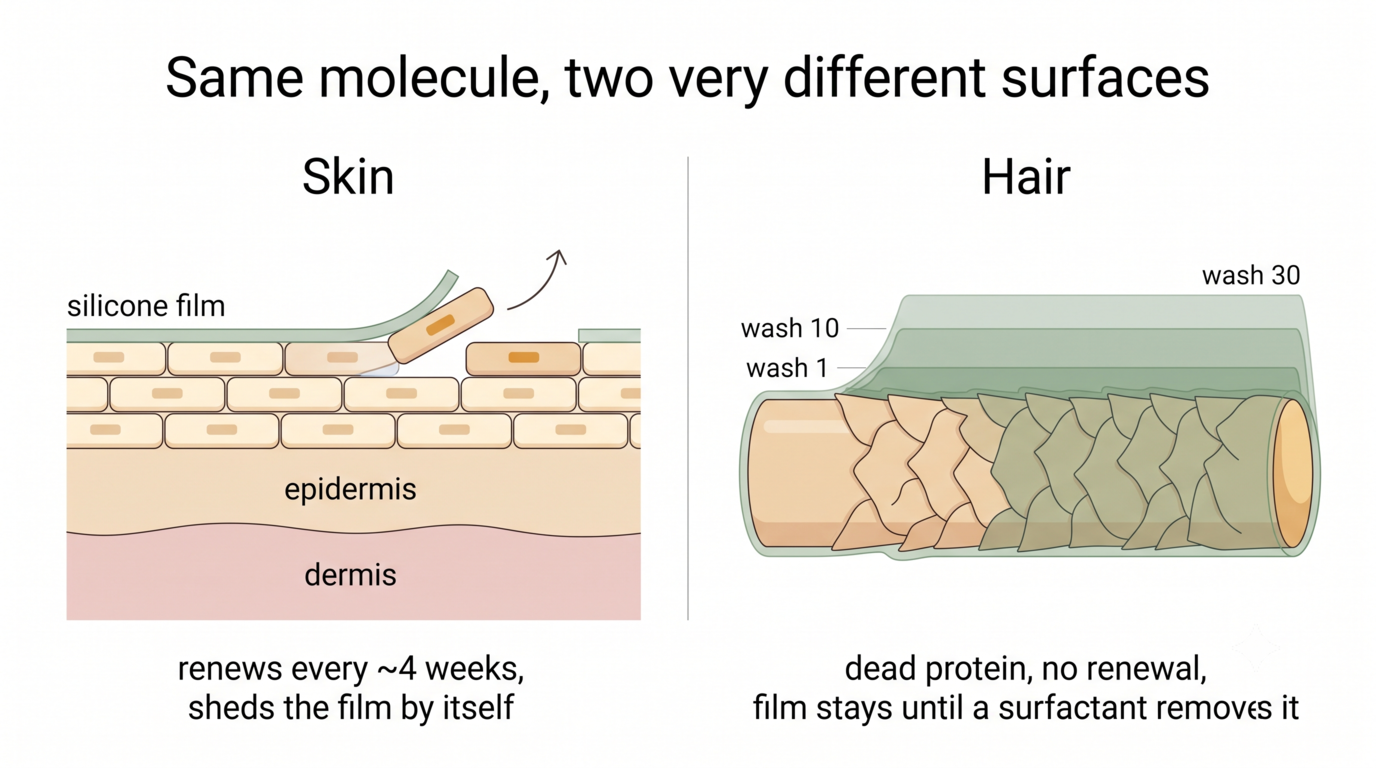
Your skin is alive and it renews itself. The stratum corneum turns over roughly every month, and every dead cell it sheds takes whatever is sitting on it along for the ride. Whatever you put on your face today is gone in a few weeks whether you like it or not. Your skin cleans its own slate.
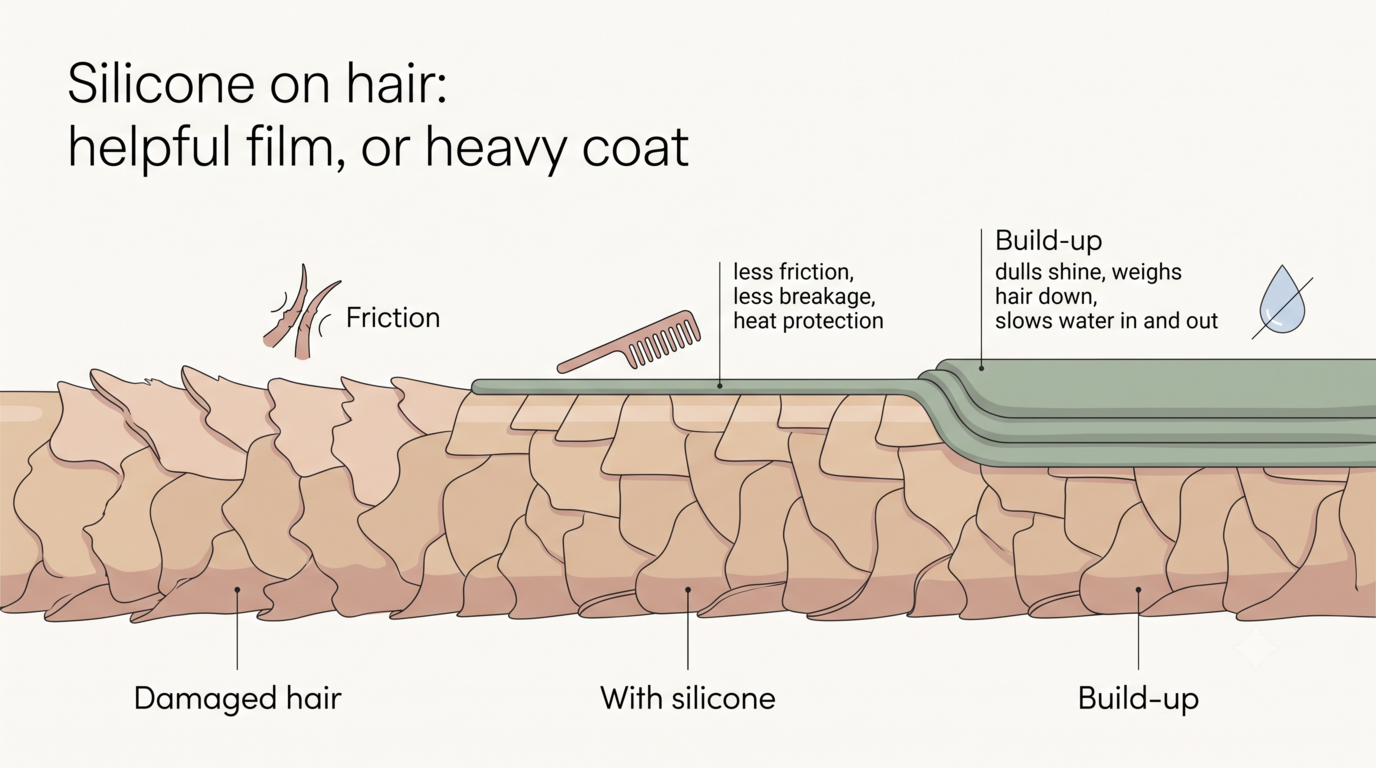
Hair does not. A hair shaft is dead protein. It has no renewal, no shedding, no self cleaning. Whatever lands on it stays there until a surfactant physically removes it, and how strongly a conditioning ingredient binds to the fibre is one of the most studied things in hair chemistry (DOI). And here is the catch: dimethicone and dimethiconol are not water soluble. Water alone does nothing to them. Even a gentle sulfate free shampoo struggles, because removing a silicone soil needs a surfactant strong enough to lift it off the surface and roll it up into a droplet that can be rinsed away (DOI).
So if you use a silicone conditioner every wash and a gentle shampoo every wash, the maths does not work. You add a bit more film than you remove, over and over. That is build-up. Layer on layer of it, dulling the shine, weighing the hair down, and making the strand feel coated but somehow lifeless.
But the drying is not what most people think
Here is the correction I had to make to my own story. For years I told people that silicones "suffocated" my hair. That is not what the evidence says.
A 2025 review in Skin Appendage Disorders looked at exactly this question and is clear about it: silicone films are breathable, they do not suffocate hair, and the dryness people complain about does not come from the silicone smothering the shaft. It comes from the cycle around it. Build-up needs strong surfactants to remove, and repeatedly clarifying with harsh shampoos is what damages the cuticle and leaves hair dry, especially fine or textured hair (DOI).
There is a second layer to it. A silicone film also sits between your hair and water, and that slows moisture moving in and out of the strand. Films on hair measurably lower how much water vapour the fibre takes up and slow how fast water diffuses through it (PubMed). Under a coated shaft you can genuinely have hair that is drier than it feels, which is exactly the strange "soft on the outside, straw on the inside" thing I could not explain at the time.
And to be completely fair to silicones, they do real good on hair too. They cut the friction between strands, so hair detangles and combs without breaking, they smooth lifted cuticle scales back down, and they protect against heat styling (DOI). Less mechanical damage means less breakage. That is not nothing, and it is why the answer is not "never use silicones on hair".
The answer is to match your silicone to your shampoo.
The one real reason silicones are disappearing
There is a genuine reason some silicones are being reformulated out of European products, and it has nothing to do with your face. It is environmental.
The cyclic silicones D4, D5 and D6 (octamethylcyclotetrasiloxane, cyclopentasiloxane and cyclohexasiloxane) are very persistent and build up in the environment. The EU restricted D4 and D5 in wash off cosmetics first, applying from 31 January 2020 (Regulation (EU) 2018/35). Then in 2024 the restriction was extended. Under Regulation (EU) 2024/1328, D4, D5 and D6 may not be placed on the market at 0.1 percent or more by weight, and for all cosmetic products other than the wash off ones already covered, meaning leave on products like your primer, foundation and sunscreen, that applies from 6 June 2027.
You will see a lot of confusion about that date online, including plenty of sources saying June 2026. June 2026 is the general date for other products. For leave on cosmetics it is 6 June 2027.
What this means in practice: over the next year a lot of your favourite primers and long wear foundations will quietly change. Cyclopentasiloxane will be swapped for things like isododecane or lighter non cyclic silicones. The formulas will feel slightly different. That is a persistence and environmental decision made by regulators, not a verdict on skin safety. Worth knowing so you are not confused when your holy grail primer suddenly feels off.
How to read a label without overthinking it
You do not need to memorise anything. Three habits are enough.
- Spot the suffix. -cone, -siloxane, -conol, -silane. That is a silicone.
- Look at the position. A silicone in the first three ingredients means the product is built around texture. That is perfect for a primer and a bit of a warning sign for a "deeply nourishing" cream that costs a fortune. If the first four things are water, a silicone, an ester and a thickener, you are buying feel.
- Check what else is in there. Silicones are not a problem, but they are also not the point. Look for the glycerin, the ceramides, the niacinamide, the fatty acids. Those are the ingredients doing the work under the film.
OK Emma great, now what's the actual takeaway?
Silicones are not a nasty on your skin. They do not clog pores, they do not suffocate anything, they are among the least reactive ingredients you can put on your face, and they are the reason your sunscreen and your primer feel wearable. What they are not is a moisturiser. They make skin feel smooth without making it hydrated, so if your skin is dry, do not let a silicone rich cream fool you into thinking the job is done.
Put them where they earn their keep, which is your day cream, your primer and your sunscreen. In a night cream they are optional.
On hair it is a different story, and my conditioner really was the problem, just not for the reason I thought. Silicone films are not smothering your hair. They build up, because hair is dead and cannot shed them, and the harsh clarifying you need to strip that build-up is what actually dries you out. Match your silicone to your shampoo, or use amodimethicone or the water soluble ones, and you get all the detangling and heat protection without the slow decline into straw.
And "silicone free" on a box tells you almost nothing about whether a product is good for you. It tells you what the marketing team decided you were afraid of.
Welcome to Skinsights. I dive in the science behind skincare so you don't have to.
Scientific References
- De Paepe K, Sieg A, Le Meur M, Rogiers V. "Silicones as Nonocclusive Topical Agents." Skin Pharmacology and Physiology. 2014;27(3):164-171. DOI
- Draelos ZD. "The science behind skin care: Moisturizers." Journal of Cosmetic Dermatology. 2018;17(2):138-144. DOI
- Zhai H, Maibach HI. "Occlusion vs. skin barrier function." Skin Research and Technology. 2002;8(1):1-6. DOI
- Yosipovitch G, Xiong GL, Haus E, Sackett-Lundeen L, Ashkenazi I, Maibach HI. "Time-dependent variations of the skin barrier function in humans: transepidermal water loss, stratum corneum hydration, skin surface pH, and skin temperature." Journal of Investigative Dermatology. 1998;110(1):20-23. DOI
- Becker LC, Bergfeld WF, Belsito DV, et al. "Safety Assessment of Dimethicone Crosspolymers as Used in Cosmetics." International Journal of Toxicology. 2014;33(2 Suppl):65S-115S. DOI
- Johnson W Jr, Bergfeld WF, Belsito DV, et al. "Safety Assessment of Cyclomethicone, Cyclotetrasiloxane, Cyclopentasiloxane, Cyclohexasiloxane, and Cycloheptasiloxane." International Journal of Toxicology. 2011;30(6 Suppl):149S-227S. DOI
- Draelos ZD, DiNardo JC. "A re-evaluation of the comedogenicity concept." Journal of the American Academy of Dermatology. 2006;54(3):507-512. DOI
- Maarouf M, Saberian C, Shi VY. "Myths, Truths, and Clinical Relevance of Comedogenicity Product Labeling." JAMA Dermatology. 2018;154(10):1131. DOI
- Tan X, Feldman SR, Chang J, Balkrishnan R. "Topical drug delivery systems in dermatology: a review of patient adherence issues." Expert Opinion on Drug Delivery. 2012;9(10):1263-1271. DOI
- Ahn CS, Culp L, Huang WW, Davis SA, Feldman SR. "Adherence in dermatology." Journal of Dermatological Treatment. 2017;28(2):94-103. DOI
- Vaidya AA, Balu K, Chavan MV, Ghosh N, Kumar A. "Organomodified Silicone Elastomer (OMSE) for Next Generation Personal Care Products." Journal of Research Updates in Polymer Science. 2013;2(2):85-96. DOI
- Mustoe TA. "Evolution of silicone therapy and mechanism of action in scar management." Aesthetic Plastic Surgery. 2008;32(1):82-92. DOI
- Jiang Q, Chen J, Tian F, Liu Z. "Silicone gel sheeting for treating hypertrophic scars." Cochrane Database of Systematic Reviews. 2021;9(9):CD013357. DOI
- Carvalho RdM, Melo DF, Kelati A, Tosti A. "With or Without Silicones? A Comprehensive Review of Their Role in Hair Care." Skin Appendage Disorders. 2025;11(6):586-589. DOI
- Gavazzoni Dias MFR. "Hair cosmetics: an overview." International Journal of Trichology. 2015;7(1):2-15. DOI
- Keis K, Huemmer CL, Kamath YK. "Effect of oil films on moisture vapor absorption on human hair." Journal of Cosmetic Science. 2007;58(2):135-145. PubMed
- Slavova T, Stanimirova R, Marinova K, Danov K. "Cleansing Mechanisms and Efficacy on Artificial Skin." Molecules. 2025;30(8):1813. DOI
- Robbins CR. Chemical and Physical Behavior of Human Hair. 5th ed. Berlin: Springer; 2012. DOI
- Commission Regulation (EU) 2018/35 of 10 January 2018 amending Annex XVII to Regulation (EC) No 1907/2006 (REACH) as regards octamethylcyclotetrasiloxane (D4) and decamethylcyclopentasiloxane (D5). EUR-Lex
- Commission Regulation (EU) 2024/1328 of 16 May 2024 amending Annex XVII to Regulation (EC) No 1907/2006 (REACH) as regards D4, D5 and D6. EUR-Lex